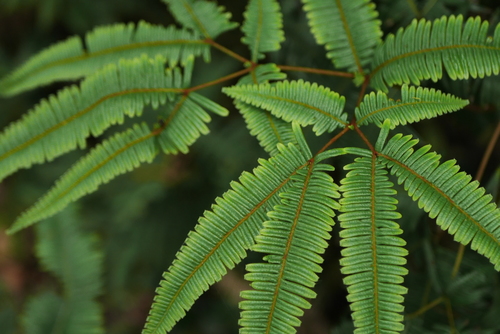


False Staghorn Fern
dicranopteris linearis
The False Staghorn Fern (Dicranopteris linearis) is a highly resilient and visually striking fern species found throughout the tropical and subtropical regions of the Old World and the Pacific. Renowned for its ability to colonize disturbed land rapidly, it often forms vast, dense, and practically impenetrable thickets on steep hillsides, clay banks, and forest edges. It plays a vital ecological role as a pioneer species, stabilizing soil and preventing landslide erosion, though its thick mats can sometimes suppress the growth of native forest seedlings. This scrambling fern is easily recognized by its unique branching habit, which creates a highly geometric and layered appearance. For hikers and nature enthusiasts, encountering a hillside blanketed in this vibrant, climbing fern is a classic signature of tropical rainforest margins.
Lebensraum: Found in open, sun-exposed tropical and subtropical locations, particularly on disturbed hillsides, clay road cuts, and rainforest margins.
This scrambling fern is distinguished by its light green to yellowish-green fronds that exhibit a distinct, repeated two-way (dichotomous) branching pattern, allowing the plant to climb and drape over other vegetation. The fronds can extend for several meters in length. At each fork, there is a prominent brown, hairy bud flanked by a pair of small, leafy bracts. The individual leaflets are linear, narrow, and deeply lobed, giving the overall foliage a delicate, ladder-like appearance. On the undersides of mature leaves, double rows of small, yellowish-brown spore-producing structures (sori) can be found.
Kategorie
PflanzenSeltenheit
Common
Gefahr
1/5 · Sehr gering
Snaps
Mach den ersten Snap!
In Hawaii, where it is known as 'Uluhe', it forms barriers so dense that early explorers occasionally had to walk over the top of the springy fern canopy rather than through it.
Its presence is an excellent indicator of highly acidic, low-nutrient soils, as it thrives where many other plant species cannot survive.
The strong, fibrous, split stems of this fern have been historically used in Southeast Asia to weave durable baskets, traps, and even as the raw material for writing pens.
Repeatedly forks into two equal branches, allowing it to scramble over other vegetation and maximize light capture in forest gaps.
Absorbs and tolerates high concentrations of aluminium from highly acidic tropical clay soils, giving it a competitive edge.
Creates dense, multi-layered mats that exclude competing weeds and preserve local soil moisture on steep, eroded slopes.
As a photosynthetic plant, it synthesizes its own food using sunlight, carbon dioxide, and water while drawing essential minerals from acidic, nutrient-poor soils.
Metrosideros polymorpha
Dicranopteris linearis competes aggressively for space and sunlight, often suppressing the regeneration of native tree seedlings.
Spodoptera litura
The leaves and fronds are sometimes consumed by the generalist caterpillars of the Oriental Leafworm Moth.
Glomus intraradices
Form of mutualism where the fern gains essential nutrients from specialized soil fungi colonizing its roots.
Für dieses Objekt sind noch keine Merkmal-Badges vergeben.
Noch keine Alternativnamen vorhanden.
Sammlungen für dieses Objekt erscheinen hier, wenn weitere Themen hinzugefügt werden.
Gefahr
1/5 · Sehr gering
Noch keine besonderen Sicherheitshinweise.
Der einfachste Weg, False Staghorn Fern zu bestimmen, ist die Verwendung der Naturführer-App Snappit.
100-600 cm
0.2-2 kg
5-20 Jahre
As a photosynthetic plant, it synthesizes its own food using sunlight, carbon dioxide, and water while drawing essential minerals from acidic, nutrient-poor soils.
Found in open, sun-exposed tropical and subtropical locations, particularly on disturbed hillsides, clay road cuts, and rainforest margins.
Zoome hinein, um Cluster aufzulösen und zu sehen, wo dieses Objekt fotografiert wurde.
Neueste Snaps erscheinen hier, wenn neue Beobachtungen hinzukommen.








.jpg&width=800)








.jpg&width=800)

