

Puncture Vine
tribulus terrestris
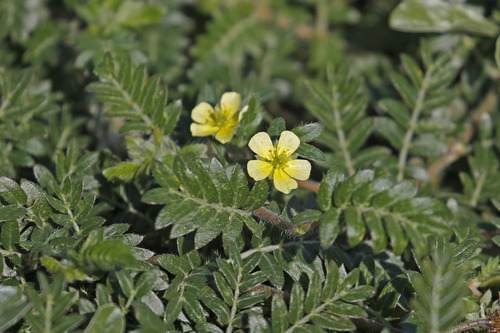
Puncture Vine (Tribulus terrestris) is a notoriously resilient, flat-growing annual herb infamous for its woody, spine-covered seed cases. Originating from warm temperate and tropical regions of the Old World, this tough survivor has successfully colonized disturbed soils and arid environments across the globe. It is widely considered a noxious weed due to its aggressive growth and the physical harm its sharp seed pods can cause to livestock, pets, and humans.
Lebensraum: Thrives in dry, compacted soils, agricultural fields, waste areas, and along sandy roadsides or pathways.
This low-growing plant forms dense, prostrate mats with stems radiating outward from a central taproot, often spreading up to one meter in diameter. Its leaves are pinnately compound, consisting of small, opposite leaflets that give it a fern-like appearance. During the warm season, it produces bright yellow, five-petaled flowers that open in the morning, followed by the distinctive, woody bur fruits which split into five sharp-spined caltrops.
Kategorie
PflanzenSeltenheit
Common
Gefahr
1/5 · Sehr gering
Snaps
Mach den ersten Snap!
Its seed pods are strong enough to puncture bicycle tires and can cause painful wounds to dogs or livestock walking through infested fields.
The plant contains steroidal saponins, which are sometimes extracted and marketed in dietary supplements aimed at boosting athletic performance and testosterone levels.
The sharp, spiked seed pod resembles a miniature version of a caltrop, a multi-pointed metal weapon used in ancient warfare to disable cavalry.
Produces extremely hard, wood-like seed cases tipped with sharp spines that effortlessly penetrate animal hooves, bicycle tires, and shoes to aid in seed dispersal.
Utilizes a deep, sturdy taproot system and finely divided leaves to efficiently store and retain water in extremely dry, sun-baked environments.
Generates highly resilient seeds that can remain dormant and viable within the soil for up to several years, waiting for optimal moisture to sprout.
As a photosynthetic plant, Puncture Vine produces its own organic energy using sunlight, carbon dioxide, and water drawn through its extensive root system.
Microlarinus lareynii
The larvae of this introduced biological control weevil feed exclusively on the seeds inside the green burs, helping to suppress plant populations.
Microlarinus lypriformis
This biological control weevil infests the stems and crown of the plant, disrupting water transport and killing the vine.
Apis mellifera
Honeybees frequently visit the bright yellow flowers during the day, collecting nectar and facilitating pollination.
Für dieses Objekt sind noch keine Merkmal-Badges vergeben.
Noch keine Alternativnamen vorhanden.
Sammlungen für dieses Objekt erscheinen hier, wenn weitere Themen hinzugefügt werden.
Gefahr
1/5 · Sehr gering
Noch keine besonderen Sicherheitshinweise.
Der einfachste Weg, Puncture Vine zu bestimmen, ist die Verwendung der Naturführer-App Snappit.
10-100 cm
0-1 Jahre
As a photosynthetic plant, Puncture Vine produces its own organic energy using sunlight, carbon dioxide, and water drawn through its extensive root system.
Thrives in dry, compacted soils, agricultural fields, waste areas, and along sandy roadsides or pathways.
Zoome hinein, um Cluster aufzulösen und zu sehen, wo dieses Objekt fotografiert wurde.
Neueste Snaps erscheinen hier, wenn neue Beobachtungen hinzukommen.











