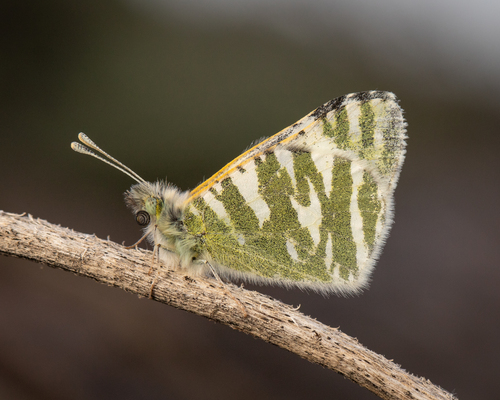


Tenerife Green Striped White
euchloe eversi
The Tenerife Green Striped White (Euchloe eversi) is an exquisite and rare butterfly endemic to the high-altitude volcanic landscapes of Tenerife in the Canary Islands. Found primarily within the subalpine zones of Teide National Park, this specialized pierid butterfly is perfectly adapted to the harsh, wind-swept environments of Mount Teide. It is highly celebrated by entomologists for its restricted geographic range and its beautiful, intricate wing patterns that serve as camouflage against volcanic rocks and high-altitude flora. As a species reliant on specific microclimates, it emerges in synchrony with the spring blooms of its host plants. Its survival is intimately linked to the unique high-altitude ecosystem of Tenerife, making it an important indicator species for the ecological health of the island's alpine zones. Spotting one of these delicate fliers darting across the rocky scree is a true highlight for any nature enthusiast visiting the Canary Islands.
Lebensraum: Found in high-altitude subalpine scrublands and rocky volcanic slopes, primarily within the Teide caldera on Tenerife.
The Tenerife Green Striped White features a wingspan of approximately 3 to 4.5 cm. The uppersides of its wings are primarily white with a distinctive black apex marked with white spots on the forewings, and a prominent black discoidal spot. The most striking feature is found on the hindwing undersides, which display an intricate, marbled pattern of bright green and white stripes. This green-and-white coloration is composed of a mix of yellow and black scales, providing perfect camouflage against the lichen-covered rocks and subalpine vegetation of its native habitat.
Kategorie
InsektenSeltenheit
Common
Gefahr
1/5 · Sehr gering
Snaps
Mach den ersten Snap!
The green stripes on the underside of their wings are actually an optical illusion created by a dense mixture of black and bright yellow scales.
Their primary larval host plant, the Broom Hare's-Ear Mustard, is also endemic to the Canary Islands, making their survival deeply interconnected.
They are found almost exclusively above 1,500 meters of elevation, thriving in the extreme, dry conditions of Tenerife's volcanic zone.
They use dorsal basking to absorb solar radiation quickly in the cool morning air of subalpine zones before taking flight.
The complex green and white marbling on the underside of their wings mimics lichen-covered volcanic rocks, rendering them virtually invisible when resting.
Pupae can undergo prolonged diapause, delaying emergence during dry years until favorable environmental conditions return.
Caterpillars feed exclusively on the leaves, flowers, and developing seed pods of endemic Brassicaceae, while adults drink nectar from various alpine wildflowers.
Altersunterschiede: Larvae are highly specialized herbivores feeding on host plant tissues, whereas adults are generalist nectar feeders on high-altitude flowers.
Descurainia bourgaeana
The caterpillars of Euchloe eversi feed exclusively on this endemic plant, which is critical for their development.
Gallotia galloti
Adult butterflies and caterpillars are preyed upon by this endemic lizard on volcanic rocks.
Für dieses Objekt sind noch keine Merkmal-Badges vergeben.
Noch keine Alternativnamen vorhanden.
Sammlungen für dieses Objekt erscheinen hier, wenn weitere Themen hinzugefügt werden.
Gefahr
1/5 · Sehr gering
Noch keine besonderen Sicherheitshinweise.
Der einfachste Weg, Tenerife Green Striped White zu bestimmen, ist die Verwendung der Naturführer-App Snappit.
2-3 cm
3-5 cm
0.0001-0.0003 kg
1 Jahre
12 km/h
Caterpillars feed exclusively on the leaves, flowers, and developing seed pods of endemic Brassicaceae, while adults drink nectar from various alpine wildflowers.
Found in high-altitude subalpine scrublands and rocky volcanic slopes, primarily within the Teide caldera on Tenerife.
Zoome hinein, um Cluster aufzulösen und zu sehen, wo dieses Objekt fotografiert wurde.
Neueste Snaps erscheinen hier, wenn neue Beobachtungen hinzukommen.



.jpg&width=800)







