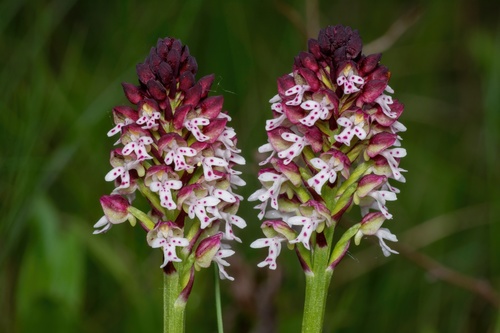


Burnt-Tip Orchid
neotinea ustulata
The Burnt-Tip Orchid (Neotinea ustulata) is a charming and highly distinctive wild orchid native to Europe. Renowned for its unique bicolor appearance, this delicate wildflower features a tightly packed spike of blossoms that look remarkably as though they have been lightly singed at the top. This striking visual effect is caused by the deep, dark-maroon-to-black coloration of the unopened buds at the apex of the cluster, which contrasts beautifully with the milky-white, pink-spotted open flowers below. Historically found across unimproved calcareous grasslands, this orchid has become a symbol of conservation, as its habitats have faced significant fragmentation. Its presence is often a key indicator of ancient, undisturbed meadows with rich underground fungal networks.
Hábitat: Typically found in undisturbed, short, chalk or limestone grasslands and meadows, often on south-facing slopes.
Standing between 10 and 28 centimeters tall, the Burnt-Tip Orchid is easily identified by its dense, cylindrical flower spike. The lower flowers are white with fine pink or purple spots on the lip, while the unopened buds at the top are a deep, dark purple-black, creating the classic 'burnt' appearance. Its leaves are unspotted, pale green, lanceolate, and primarily clustered at the base of the stem, with a few smaller leaves clasping the stem higher up.
Categoría
PlantasRareza
Common
Peligro
1/5 · Muy bajo
Snaps
¡Sé la primera persona en hacer un snap!
It emits a delightful, strong scent of vanilla, particularly on warm, sunny afternoons, to attract its insect pollinators.
Some individuals can remain completely dormant underground for several years, supported only by their symbiotic fungi, before suddenly reappearing.
The orchid gets its common name 'Burnt-Tip' because the dark purple buds at the top of the spike make it look like it has been singed by fire.
Its microscopic seeds lack nutrient reserves and rely entirely on mycorrhizal soil fungi to germinate and survive underground for several years before producing leaves.
The orchid can remain dormant underground for multiple seasons during drought or unfavorable conditions, relying on its tubers for survival.
It emits a strong, sweet, vanilla-like fragrance during the day to attract specific insect pollinators like beetles and flies.
As a photosynthetic plant, it generates its own energy from sunlight, water, and carbon dioxide, while obtaining minerals and water via a symbiotic fungal network.
Diferencias por edad: Seedlings are completely mycoheterotrophic, relying entirely on fungi for nutrients, before developing green leaves to photosynthesize as adults.
Ceratobasidium cornigerum
Serves as a vital symbiotic partner facilitating seed germination and subterranean growth.
Leptura livida
One of the key insect pollinators attracted to the sweet vanilla scent of the flowers.
Aún no hay insignias de rasgos asignadas a este objeto.
Todavía no hay alias listados.
Las colecciones para este objeto aparecerán aquí a medida que se añadan más temas.
Peligro
1/5 · Muy bajo
Todavía no hay notas especiales de seguridad.
La forma más fácil de identificar a Burnt-Tip Orchid es usar la aplicación de identificación de naturaleza Snappit.
10-28 cm
0.01-0.05 kg
10-30 años
As a photosynthetic plant, it generates its own energy from sunlight, water, and carbon dioxide, while obtaining minerals and water via a symbiotic fungal network.
Typically found in undisturbed, short, chalk or limestone grasslands and meadows, often on south-facing slopes.
Acércate para separar los grupos y explorar dónde se ha fotografiado este objeto.
Los snaps recientes aparecerán aquí a medida que se añadan nuevas observaciones.



.jpg&width=800)




.jpg&width=800)











