

Pale Gentian
gentiana alba
The Pale Gentian (Gentiana alba), also known as the cream gentian, is a striking, long-lived perennial wildflower native to the tallgrass prairies and open woodlands of North America. Standing tall on sturdy, unbranched stems, this rare beauty is highly prized by plant enthusiasts for its elegant, yellowish-white flowers that resemble tightly closed buds. Unlike many other wildflowers that open widely to invite all pollinators, the Pale Gentian keeps its petals closed, guarding its nectar for only the strongest and most determined insect visitors. This slow-growing plant plays an important role in its native ecosystems, offering a late-summer feast for robust native bees. Observing a Pale Gentian in the wild is a true treat, as its populations have declined significantly due to habitat loss, making it a symbol of the vanishing, high-quality prairie habitats of the American Midwest.
Hábitat: Found in high-quality tallgrass prairies, open oak savannas, limestone glades, and rocky, open woodlands.
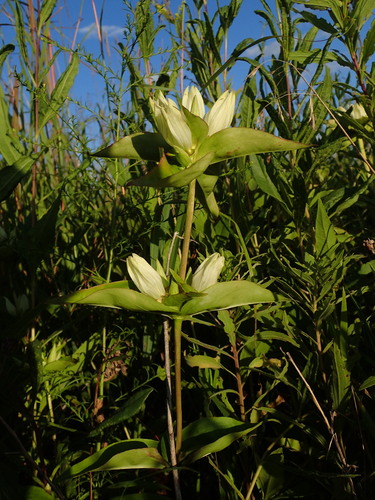
This perennial herb grows upright, reaching heights of 30 to 90 cm, with smooth, light green, opposite leaves that are lance-shaped and clasp the stem. The most distinguishing feature is the terminal cluster of 2 to 10 bottle-shaped, creamy-white to pale yellowish-green flowers, each measuring 3 to 5 cm in length. These flowers remain mostly closed, with only a small opening at the tip, and lack any blue coloration, setting them apart from other native gentians.
Categoría
PlantasRareza
Common
Peligro
1/5 · Muy bajo
Snaps
¡Sé la primera persona en hacer un snap!
Gentian roots contain gentiopicroside, an extremely bitter compound historically used in traditional herbal medicine to stimulate digestion.
Only robust bumblebees are strong enough to pry open the tightly closed petals to reach the nectar inside, effectively reserving the plant's resources for its best pollinators.
The flowers of the Pale Gentian look like buds that never open, earning them the nickname 'bottle gentian' alongside some of their close relatives.
The corolla remains nearly closed, protecting delicate reproductive organs and nectar from rain and weak, non-pollinating insects.
A thick, fleshy taproot allows the plant to access deep water reserves, helping it survive periods of drought and prairie fires.
Blooming late in the summer when many other wildflowers have faded, it capitalizes on remaining pollinator activity.
As a photosynthetic plant, the Pale Gentian produces its own food using sunlight, water, and carbon dioxide, while absorbing essential minerals from the soil.
Bombus impatiens
Bumblebees are strong enough to force open the closed petals to pollinate the flowers and obtain rich nectar.
Odocoileus virginianus
Deer occasionally browse on the leaves and flowering stems of the plant, though it is not their primary food source.
Aún no hay insignias de rasgos asignadas a este objeto.
Todavía no hay alias listados.
Las colecciones para este objeto aparecerán aquí a medida que se añadan más temas.
Peligro
1/5 · Muy bajo
Todavía no hay notas especiales de seguridad.
La forma más fácil de identificar a Pale Gentian es usar la aplicación de identificación de naturaleza Snappit.
30-90 cm
5-20 años
As a photosynthetic plant, the Pale Gentian produces its own food using sunlight, water, and carbon dioxide, while absorbing essential minerals from the soil.
Found in high-quality tallgrass prairies, open oak savannas, limestone glades, and rocky, open woodlands.
Photosynthesis
Acércate para separar los grupos y explorar dónde se ha fotografiado este objeto.
Los snaps recientes aparecerán aquí a medida que se añadan nuevas observaciones.