

Kiawe
neltuma pallida
Kiawe (Neltuma pallida, formerly Prosopis pallida) is an incredibly resilient, thorny tree in the legume family. Native to the dry coastal regions of South America, it has successfully naturalized across several tropical regions worldwide, most notably in the Hawaiian Islands. Renowned for its ability to thrive in hyper-arid and saline conditions where little else can grow, Kiawe plays a dual role: it is highly valued for producing premium honey, charcoal, and livestock feed, yet it is also viewed as a highly aggressive invasive species that outcompetes native vegetation. Its deep taproots and sharp thorns make it a formidable and dominant presence in arid landscapes.
生息地: Found in dry coastal lowlands, arid shrublands, sandy beaches, and disturbed plains, frequently thriving in brackish or hyper-saline soils.
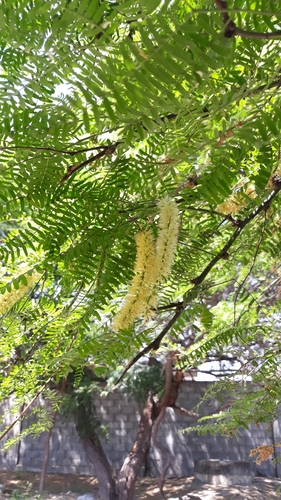
Kiawe typically grows as a sprawling tree reaching heights of 8 to 15 meters, often featuring a highly twisted, rustic trunk and dusty grey-brown bark. Its branches are armed with sharp, stout thorns that can measure up to several centimeters in length. The foliage consists of pale, dusty-green, bipinnately compound leaves that help the plant minimize water loss under the scorching sun. During its flowering period, it produces dense, cylindrical spikes of pale yellow or greenish-yellow blossoms, which eventually mature into long, hanging, straw-colored seed pods resembling pale green beans.
カテゴリ
植物レア度
Common
危険度
1/5 · 非常に低い
スナップ
最初にスナップしよう!
Every Kiawe tree in the Hawaiian islands is believed to descend from a single seed planted in Honolulu in 1828 by Father Alexis Bachelot.
Its thorns are so notoriously tough and sharp they are known to easily puncture bicycle tires and even thin-soled footwear.
Kiawe wood is globally famous for barbecue, imparting a distinct, sweet, and heavy smoky flavor that is highly sought after by chefs.
Deploys an exceptionally deep taproot system that can reach up to 50 meters underground, allowing the tree to access deep water tables during severe droughts.
Exhibits a superb ability to filter and tolerate high concentrations of soil salinity, allowing it to grow directly along oceanic coastlines.
Partners with specialized soil bacteria to convert atmospheric nitrogen into a usable organic form, enriching poor and sandy soils.
Like other plants, Kiawe is a photoautotroph that generates its own chemical energy by capturing sunlight and converting carbon dioxide and water into sugars.
Apis mellifera
Bees actively forage on the pale yellow flowers to produce a highly prized, delicate white honey.
Bos taurus
Grazing livestock feed on the sweet, fallen seed pods, subsequent dispersing the durable seeds in their manure.
Cenchrus ciliaris
An aggressive grass species that competes with Kiawe for water and nutrients in dry, fire-prone habitats.
このオブジェクトにはまだ特徴バッジが割り当てられていません。
まだ別名はありません。
テーマが追加されると、このオブジェクトのコレクションがここに表示されます。
危険度
1/5 · 非常に低い
まだ特別な安全上の注意はありません。
Kiaweを識別する最も簡単な方法は、Snappit自然識別アプリを使用することです。
800+ cm
50+ 年
Like other plants, Kiawe is a photoautotroph that generates its own chemical energy by capturing sunlight and converting carbon dioxide and water into sugars.
Found in dry coastal lowlands, arid shrublands, sandy beaches, and disturbed plains, frequently thriving in brackish or hyper-saline soils.
ズームインしてクラスターを分割し、このオブジェクトが撮影された場所を探索しましょう。
新しい観察が追加されると、ここに最近のスナップが表示されます。


















