

Monactinus Biwae
monactinus biwae
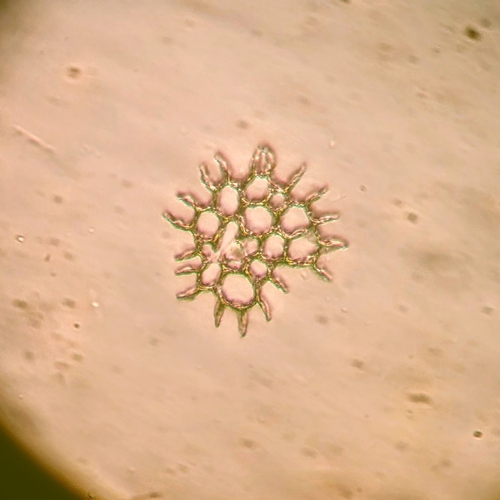
Monactinus Biwae is a beautiful, microscopic green alga renowned for its striking star-like geometric symmetry. Operating as a free-floating colonial organism, it consists of a single-layered disc of cells precisely arranged in concentric rings. This microalga plays a vital role in freshwater food webs, serving as a primary producer that converts solar energy into organic matter while oxygenating its aquatic environment.
生息地: Inhabits the open waters of freshwater lakes, reservoirs, and slow-moving rivers, thriving as a component of floating phytoplankton.
Under a microscope, Monactinus Biwae resembles a green, wheel-like structure or gear. It forms flat, disc-shaped colonies (coenobia) typically consisting of 8, 16, 32, or 64 cells. The inner cells are polygonal and fit tightly together, while each outer cell is characterized by a single, prominent, outward-pointing horn or spine, giving the entire colony a starburst appearance. The cells are rich in green chlorophyll, which gives them a vibrant, grass-green coloration.
カテゴリ
植物レア度
Common
危険度
1/5 · 非常に低い
スナップ
最初にスナップしよう!
It is named after Lake Biwa in Japan, the country's largest freshwater lake, where it was historically studied in detail.
Its outer cells feature a single horn-like projection, which distinguishes the genus Monactinus from its close relative Pediastrum, which typically has two.
The number of cells in a colony is determined at birth and does not increase; individual cells simply grow larger as the colony matures.
The flat, single-layered disc structure maximizes surface area exposure to sunlight, optimizing the efficiency of its photosynthetic process.
During reproduction, motile zoospores gather inside a temporary vesicle and spontaneously align into a perfect geometric colony before developing cell walls.
The cell wall contains robust, decay-resistant biopolymers that protect the colony from sudden osmotic shifts and physical damage.
As a photosynthetic organism, it manufactures its own food using sunlight, carbon dioxide, and dissolved inorganic nutrients from the water.
Daphnia pulex
Serves as a vital source of nutrition for filter-feeding zooplankton.
Microcystis aeruginosa
Competes for dissolved phosphorus and nitrogen in freshwater lakes.
このオブジェクトにはまだ特徴バッジが割り当てられていません。
まだ別名はありません。
テーマが追加されると、このオブジェクトのコレクションがここに表示されます。
危険度
1/5 · 非常に低い
まだ特別な安全上の注意はありません。
Monactinus Biwaeを識別する最も簡単な方法は、Snappit自然識別アプリを使用することです。
0 cm
As a photosynthetic organism, it manufactures its own food using sunlight, carbon dioxide, and dissolved inorganic nutrients from the water.
Inhabits the open waters of freshwater lakes, reservoirs, and slow-moving rivers, thriving as a component of floating phytoplankton.
Photosynthesis
8-64
ズームインしてクラスターを分割し、このオブジェクトが撮影された場所を探索しましょう。
新しい観察が追加されると、ここに最近のスナップが表示されます。