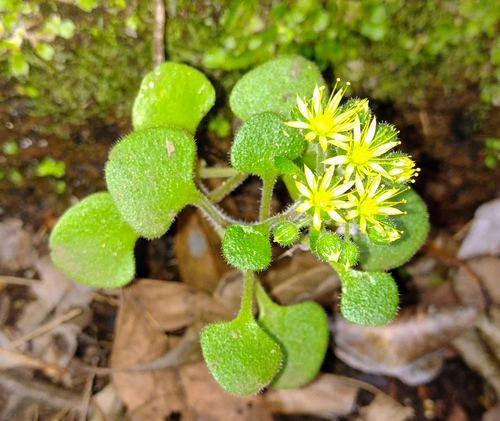


Tree Of Love
aichryson laxum
The Tree of Love (Aichryson laxum) is an enchanting subtropical succulent plant that brings a touch of magic to both wild rocky slopes and cozy window sills. Endemic to the Canary Islands, this delicate plant naturally forms a miniature, tree-like silhouette with fork-like branches and plush, green foliage. During its flowering season, it erupts in a dramatic display of golden, star-shaped blossoms that contrast beautifully against its dark green leaves. Its common name is inspired by its soft, spade-to-heart-shaped leaves and its remarkable ability to easily propagate and multiply.
生息地: Found in damp, shaded ravines, rocky walls, and woodlands of the Canary Islands, often growing in volcanic soil crevices.
This small, dichotomously branched succulent grows up to 30 to 50 centimeters in height, resembling a tiny, rounded tree. Its fleshy leaves are light to dark green, spade-shaped, and covered in a dense coat of short, velvety white hairs that give the plant a soft, fuzzy texture. In late winter and spring, it produces airy, branched clusters of numerous bright yellow flowers, each featuring 8 to 12 narrow, star-like petals.
カテゴリ
植物レア度
Common
危険度
1/5 · 非常に低い
スナップ
最初にスナップしよう!
It is called the 'Tree of Love' because its small, velvety green leaves slightly resemble hearts, and it easily shares 'offspring' through stem cuttings.
The genus name Aichryson is derived from Greek words meaning 'always golden,' referencing the vibrant and long-lasting yellow blooms of the species.
Unlike many desert succulents, this plant thrives in moisture and shade, preferring damp forest edges to dry, sun-scorched plains.
The fine, soft hairs covering its leaves help reduce water loss from evaporation and trap ambient moisture from coastal fog.
Its stems naturally fork into two equal branches, helping the plant maximize its leaf surface area to capture filtered light in shaded environments.
Fallen or broken stems can rapidly develop adventitious roots when they come into contact with moist soil, allowing the plant to colonize new areas vegetative-wise.
As a photosynthetic plant, it generates its own energy from sunlight, water, and carbon dioxide, while drawing minerals from the surrounding soil.
Bombus canariensis
The bright yellow flowers provide vital nectar and pollen during the spring for native bees.
Cornu aspersum
Terrestrial mollusks feed on the tender, water-rich leaves of the plant in damp microclimates.
このオブジェクトにはまだ特徴バッジが割り当てられていません。
まだ別名はありません。
テーマが追加されると、このオブジェクトのコレクションがここに表示されます。
危険度
1/5 · 非常に低い
まだ特別な安全上の注意はありません。
Tree Of Loveを識別する最も簡単な方法は、Snappit自然識別アプリを使用することです。
15-50 cm
0.1-1.5 kg
2-5 年
As a photosynthetic plant, it generates its own energy from sunlight, water, and carbon dioxide, while drawing minerals from the surrounding soil.
Found in damp, shaded ravines, rocky walls, and woodlands of the Canary Islands, often growing in volcanic soil crevices.
14-30 日
ズームインしてクラスターを分割し、このオブジェクトが撮影された場所を探索しましょう。
新しい観察が追加されると、ここに最近のスナップが表示されます。
















