

Acer Sect. Ginnala
ginnala
The Amur maple (Acer sect. Ginnala) is a exceptionally hardy, deciduous small tree or large shrub native to northeastern Asia. Celebrated for its remarkable seasonal color transitions, it sports glossy green leaves in the summer that explode into brilliant hues of fiery red and deep orange during the autumn months. It is highly valued in horticulture for its compact size, cold tolerance, and adaptability, making it a favorite for windbreaks, urban landscaping, and bonsai art. By offering fragrant early-spring blossoms and high-energy seeds in winter, it supports a diverse range of local wildlife.
Lebensraum: Native to river valleys, forest edges, and open woodlands of East Asia, it also thrives in urban environments, parks, and suburban gardens across North America.
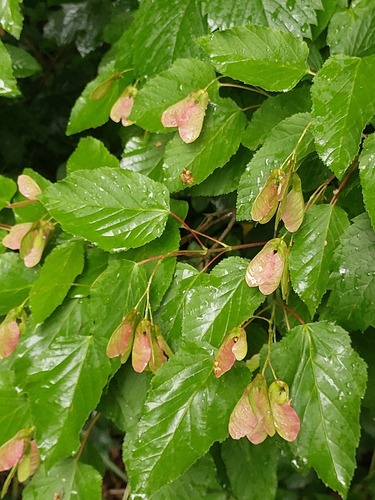
Growing as a multi-stemmed large shrub or small tree between 300 to 1000 cm in height, it displays a rounded, dense canopy. Its leaves are oppositely arranged and deeply three-lobed, with the central lobe being significantly longer than the side lobes, featuring sharply double-serrated margins. In spring, it produces small, fragrant, greenish-yellow flowers in long-peduncled panicles, which later develop into distinctively reddish-brown winged samaras about 2 to 3 cm long.
Kategorie
PflanzenSeltenheit
Common
Gefahr
1/5 · Sehr gering
Snaps
Mach den ersten Snap!
The leaves of this maple contain a high concentration of tannins, which historically have been used to produce a dark black dye for textiles.
The specific section name 'ginnala' is derived from a local Russian vernacular name for this tree in the Amur River region.
Unlike most other maple species whose flowers are nearly scentless, the blossoms of the Amur maple are remarkably fragrant.
Survives winter temperatures drop as low as -40 degrees Celsius, allowing it to thrive in subarctic climates.
Produces intense red anthocyanin pigments in autumn to protect leaves from light damage while recycling key nutrients.
Develops a highly branched, fibrous root system that efficiently extracts moisture from dry or compacted urban soils.
Synthesizes sugars through photosynthesis using sunlight, water, and carbon dioxide, while absorbing essential macro- and micronutrients through its roots.
Anoplophora glabripennis
Larvae burrow into the trunk and branches, causing significant structural damage to the tree.
Apis mellifera
Bees gather nectar and pollen from the highly fragrant spring blossoms, aiding in pollination.
Bombycilla cedrorum
Birds feed on the winged samaras during late fall and winter, dispersing the seeds over wide distances.
Für dieses Objekt sind noch keine Merkmal-Badges vergeben.
Sammlungen für dieses Objekt erscheinen hier, wenn weitere Themen hinzugefügt werden.
Gefahr
1/5 · Sehr gering
Noch keine besonderen Sicherheitshinweise.
Der einfachste Weg, Acer Sect. Ginnala zu bestimmen, ist die Verwendung der Naturführer-App Snappit.
300-1000 cm
60-100 Jahre
Synthesizes sugars through photosynthesis using sunlight, water, and carbon dioxide, while absorbing essential macro- and micronutrients through its roots.
Native to river valleys, forest edges, and open woodlands of East Asia, it also thrives in urban environments, parks, and suburban gardens across North America.
Zoome hinein, um Cluster aufzulösen und zu sehen, wo dieses Objekt fotografiert wurde.
Neueste Snaps erscheinen hier, wenn neue Beobachtungen hinzukommen.












.jpg&width=800)