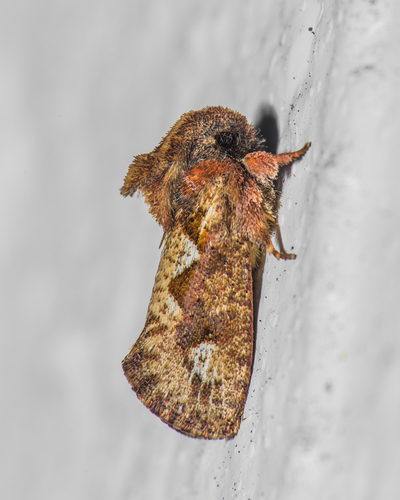


Acrolophus Walsinghami
acrolophus walsinghami
Acrolophus Walsinghami, commonly known as Walsingham's Grass Moth, is a fascinating nocturnal insect belonging to the family Tineidae. These moths are part of a diverse group known for their often cryptic coloration and unique larval habits. While the adult moths might appear unassuming, their life cycle, particularly the larval stage, is intricately linked to the soil and plant roots, where they construct protective silken tubes. This species plays a role in its ecosystem by contributing to nutrient cycling, especially through its larval feeding on detritus or plant roots. Their widespread distribution across various North American habitats makes them a common yet often overlooked component of grassland and open woodland ecosystems, highlighting the hidden biodiversity present even in familiar landscapes.
Lebensraum: Acrolophus Walsinghami is typically found in open grassy areas, meadows, old fields, and woodland edges where their host plants or decaying organic matter are abundant.
Walsingham's Grass Moth is a relatively small moth, typically exhibiting an overall dusky brown or grayish coloration, which provides excellent camouflage against tree bark or leaf litter. The forewings are often mottled with darker spots or streaks, sometimes featuring subtle intricate patterns that can be difficult to discern without close inspection. The hindwings are usually plainer and lighter in color. While specific patterns can vary, the general appearance is robust for its size, with a wingspan ranging from approximately 1.8 to 2.5 centimeters. Its antennae are often simple, and when at rest, the wings are typically held in a roof-like manner over the body.
Kategorie
InsektenSeltenheit
Common
Gefahr
1/5 · Sehr gering
Snaps
Mach den ersten Snap!
Larvae of Acrolophus moths are sometimes called 'tubeworms' because they create silk-lined tunnels in the soil where they reside.
Like many moths, Acrolophus Walsinghami navigate using moonlight or polarized light, which is why artificial lights can disorient them.
The 'Acrolophus' genus name refers to a 'pointed crest,' which some species exhibit, though not always prominent in Walsinghami.
The moth's dull, mottled coloration allows it to blend seamlessly into its surroundings, making it incredibly difficult for predators to spot while it rests during the day.
The larvae construct silken tubes in the soil, providing protection from predators and environmental extremes while they feed on roots or detritus.
Adult moths are primarily active at night, a common adaptation that helps them avoid diurnal predators and locate mates under the cover of darkness.
The larvae of Acrolophus Walsinghami are primarily detritivores or herbivores, feeding on decaying plant material or the roots of grasses and other herbaceous plants. Adult moths typically do not feed or consume very little, relying on energy reserves accumulated during the larval stage.
Altersunterschiede: Larvae actively feed and grow, while adults have a reduced or non-existent feeding requirement, focusing instead on reproduction.
Carabidae
The larvae are preyed upon by various ground-dwelling insects and small mammals.
Myotis lucifugus
The adult moths serve as a food source for nocturnal insectivores.
Schedonorus arundinaceus
Larvae feed on the roots of various grasses, potentially impacting their growth.
Braconidae
Parasitic wasps lay eggs on or in the moth's larvae, leading to the death of the host.
Für dieses Objekt sind noch keine Merkmal-Badges vergeben.
Noch keine Alternativnamen vorhanden.
Sammlungen für dieses Objekt erscheinen hier, wenn weitere Themen hinzugefügt werden.
Gefahr
1/5 · Sehr gering
Noch keine besonderen Sicherheitshinweise.
Der einfachste Weg, Acrolophus Walsinghami zu bestimmen, ist die Verwendung der Naturführer-App Snappit.
0-1 cm
1-2 cm
0.0001-0.001 kg
0-1 Jahre
The larvae of Acrolophus Walsinghami are primarily detritivores or herbivores, feeding on decaying plant material or the roots of grasses and other herbaceous plants. Adult moths typically do not feed or consume very little, relying on energy reserves accumulated during the larval stage.
Acrolophus Walsinghami is typically found in open grassy areas, meadows, old fields, and woodland edges where their host plants or decaying organic matter are abundant.
Foraging
Zoome hinein, um Cluster aufzulösen und zu sehen, wo dieses Objekt fotografiert wurde.
Neueste Snaps erscheinen hier, wenn neue Beobachtungen hinzukommen.













