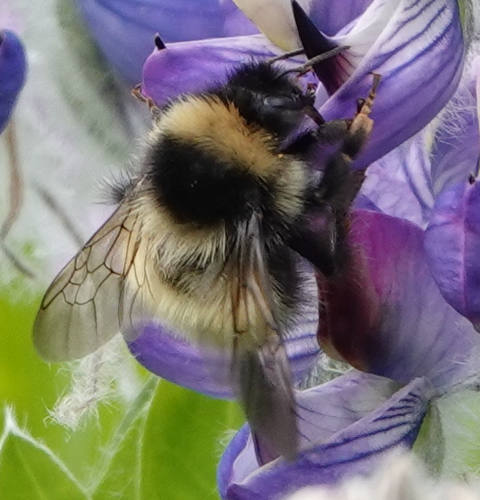


Active Bumble Bee
bombus neoboreus
The Active Bumble Bee, also known by its scientific name Bombus neoboreus (and sometimes referred to as Bombus polaris due to its habitat), is a resilient and vital pollinator native to the cold, northern regions of the world. These fuzzy insects play a crucial role in the ecosystems of the Arctic and subarctic, where they are often one of the few active pollinators during the short summer seasons. Adapted to harsh environments, they exhibit remarkable thermoregulation abilities, allowing them to forage in temperatures too low for many other insects. Their sturdy build and thick insulation make them iconic symbols of northern biodiversity and essential contributors to the reproduction of arctic flora.
Lebensraum: Found in tundra, arctic and subarctic heaths, open woodlands, and cold, flowery meadows.
Bombus neoboreus is a medium to large-sized bumble bee, typically robust and heavily furred. The queens are the largest, followed by males and workers. Visually, they often display a striking pattern: the front part of the thorax is pale yellow, followed by a broad black band between the wing bases. The first abdominal segment (T1) is also yellow, while the second and third (T2-T3) are usually black. The posterior segments (T4-T5) often feature another band of pale yellow, and the tail (T6) is typically white or off-white. This distinct banding, especially the black mid-thoracic band and white tail, helps in identification. Their wings are somewhat dusky.
Kategorie
InsektenSeltenheit
Common
Gefahr
1/5 · Sehr gering
Snaps
Mach den ersten Snap!
Bombus neoboreus can fly in temperatures as low as 0°C (32°F) due to its impressive ability to generate heat internally.
Queens of this species often establish their nests underground in abandoned rodent burrows or under moss and rocks, providing insulation from the cold.
They have an exceptionally long tongue, allowing them to access nectar from deep, tubular flowers that other shorter-tongued bees cannot reach.
This species is one of the highest-latitude insect pollinators, essential for the reproduction of many arctic berries and wildflowers that support northern wildlife.
Bombus neoboreus can shiver its flight muscles without moving its wings, generating internal heat to maintain a high body temperature even in cold ambient conditions, allowing early and late season foraging.
This bee employs sonication, vibrating its flight muscles at specific frequencies to dislodge pollen from flowers that hold it tightly, such as those of the Ericaceae family, which is crucial for many arctic plants.
Adapted to short and cold growing seasons, these bumble bees are capable of foraging in lower temperatures and harsher weather conditions than many other bee species, maximizing pollination opportunities in their extreme habitats.
The Active Bumble Bee feeds exclusively on nectar and pollen collected from a variety of flowering plants. Nectar provides carbohydrates for energy, while pollen supplies essential proteins and nutrients for growth and reproduction.
Salix arctica
Primary food source providing nectar and pollen.
Rubus chamaemorus
Primary food source providing nectar and pollen.
Lanius borealis
Predator that may catch foraging bees.
Bombus hyperboreus
A cuckoo bumble bee that lays its eggs in the nests of other bumble bees, including Bombus neoboreus, exploiting their resources.
Für dieses Objekt sind noch keine Merkmal-Badges vergeben.
Noch keine Alternativnamen vorhanden.
Sammlungen für dieses Objekt erscheinen hier, wenn weitere Themen hinzugefügt werden.
Gefahr
1/5 · Sehr gering
Noch keine besonderen Sicherheitshinweise.
Der einfachste Weg, Active Bumble Bee zu bestimmen, ist die Verwendung der Naturführer-App Snappit.
11-25 cm
2-5 cm
0.0001-0.0005 kg
0-1 Jahre
20 km/h
The Active Bumble Bee feeds exclusively on nectar and pollen collected from a variety of flowering plants. Nectar provides carbohydrates for energy, while pollen supplies essential proteins and nutrients for growth and reproduction.
Found in tundra, arctic and subarctic heaths, open woodlands, and cold, flowery meadows.
Zoome hinein, um Cluster aufzulösen und zu sehen, wo dieses Objekt fotografiert wurde.
Neueste Snaps erscheinen hier, wenn neue Beobachtungen hinzukommen.














.jpg&width=800)



