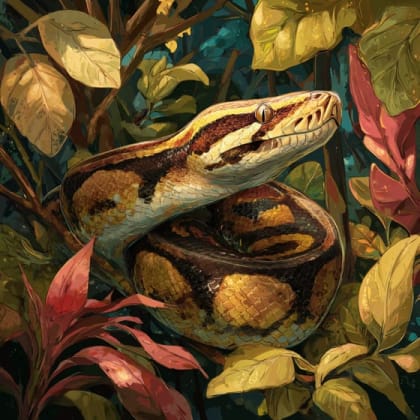
Aesculapian Snake
Zamenis longissimus
The Aesculapian Snake is a long, slender snake that is usually green or yellowish. It loves to climb trees and can often be found basking in the sun on warm rocks.
Lebensraum: Forests
The Aesculapian Snake has a slender, glossy body, typically olive-green, yellowish-brown, or greyish-brown. It often displays faint pale stripes or scattered white flecks, and its smooth scales give it a distinctive sheen. Its yellow-white chin and throat often stand out.
Kategorie
ReptilienSeltenheit
Common
Gefahr
1/5 · Sehr gering
Snaps
Mach den ersten Snap!
In ancient Greece, these docile snakes were kept in temples, symbolizing healing and renewal.
This snake is named after Asclepius, the Greek god of medicine, whose staff features two snakes!
Unlike many snakes, it can have tiny, almost invisible white spots scattered over its smooth scales.
Young Aesculapian Snakes often have a distinct dark collar that disappears as they grow older!
Aesculapian Snakes can climb trees and ruins with ease because of their strong, agile bodies that help them hunt and escape.
Aesculapian Snakes have powerful muscles that help them constrict prey, squeezing small animals until they can no longer breathe.
Aesculapian Snakes can regulate their body temperature by basking in the sun, which helps them stay active and digest food.
This snake is a carnivore that ambushes small, warm-blooded animals and birds.
Altersunterschiede: Young snakes primarily eat lizards and insects before switching to larger prey as adults.
Mus musculus
A primary food source in its varied diet.
Apodemus sylvaticus
A common prey item in woodlands and fields.
%2C_Parc_de_Woluw%C3%A9%2C_Brussels_(13042792905).jpg&width=800)
Parus major
Preys on nests, consuming eggs and fledglings.
Buteo buteo
A potential aerial predator when basking in open areas.
Martes foina
A terrestrial predator that hunts snakes on the ground.
Einzelgänger leben den größten Teil ihres Lebens allein und interagieren mit Artgenossen nur zur Paarung oder zur Aufzucht der Jungen.
Baumbewohnende Tiere leben hauptsächlich in Bäumen und nutzen diese als Unterschlupf, Nahrungsquelle und zum Schutz vor Raubtieren.
Farbenfroh beschreibt Organismen oder Objekte, die eine große Vielfalt an leuchtenden und deutlich erkennbaren Farben aufweisen.
Getarnt beschreibt Organismen, die über eine Färbung oder Musterung verfügen, durch die sie mit ihrer Umgebung verschmelzen.

Waldlebensräume sind terrestrische Lebensräume, die von dichtem Baumbestand dominiert werden und eine große Vielfalt an Pflanzen- und Tierarten beherbergen.

Dieses Merkmal kennzeichnet Organismen, deren Ernährung vollständig oder hauptsächlich aus tierischem Gewebe besteht.

Dieses Merkmal kennzeichnet Lebewesen, die bei der Jagd, Flucht oder Fortbewegung eine außergewöhnliche Schnelligkeit aufweisen.

Tagaktive Tiere sind hauptsächlich bei Tageslicht aktiv und ruhen oder schlafen in der Regel nachts.
Gefahr
1/5 · Sehr gering
If you see a snake, it's best to stay calm and walk away. Snakes are usually not dangerous.
140-200 cm
0.5-2 kg
15-25 Jahre
8 km/h
This snake is a carnivore that ambushes small, warm-blooded animals and birds.
2 km/h
Forests
Ambush
Zoome hinein, um Cluster aufzulösen und zu sehen, wo dieses Objekt fotografiert wurde.
Neueste Snaps erscheinen hier, wenn neue Beobachtungen hinzukommen.