
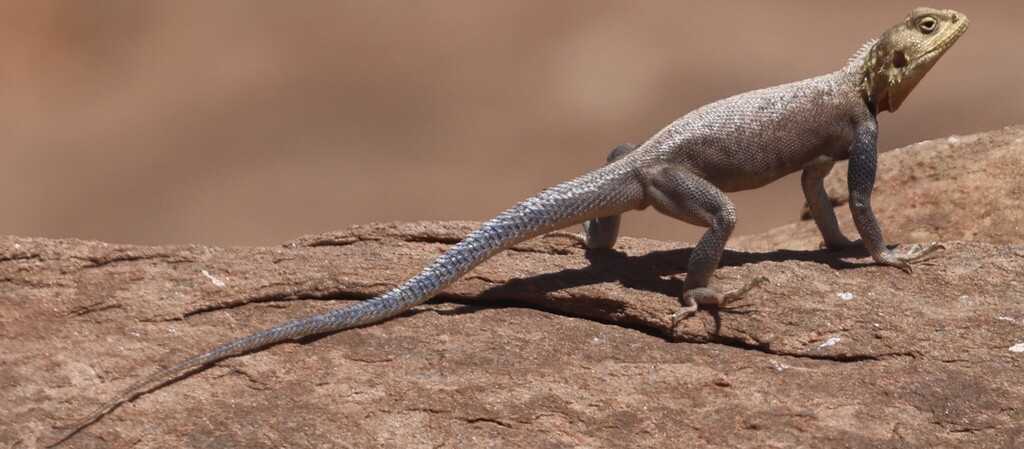





Agama somalica
Agama somalica
The Somali agama is a colorful lizard that loves to bask in the sun. With its bright colors, it can be found in rocky areas and grasslands, making it a fun creature to spot!
Lebensraum: Grasslands
The Agama somalica male is striking, featuring a bright blue head often marked with red or orange, contrasting with a mottled brown body. Females and juveniles display more subdued shades of brown and grey, providing excellent camouflage against rocky desert environments.
Kategorie
ReptilienSeltenheit
Common
Gefahr
1/5 · Sehr gering
Snaps
Mach den ersten Snap!
Agamas often stand on their hind legs to get a better view of their surroundings!
Males often do "push-ups" with their heads to show dominance or attract females!
Their scales are incredibly tough, protecting them from sharp rocks and predators!
They can run on their back legs for short distances to escape danger quickly!
Agama somalica can quickly change its skin color from light to dark because it helps them regulate body temperature by absorbing or reflecting heat.
Agama somalica has strong claws and rough scales that help them securely grip and climb steep, rocky surfaces with ease.
Agama somalica can communicate using a series of head bobs that helps them show dominance, attract mates, or warn rivals.
This lizard eats many tiny bugs and sometimes plants, staying active during the day to hunt.
Aquila rapax
A common bird of prey that hunts small lizards.
Naja pallida
A snake predator found in the same arid habitats.
Messor barbarus
A primary food source, often foraged from the ground.
Schistocerca gregaria
Opportunistically feeds on these abundant insects.
Einzelgänger leben den größten Teil ihres Lebens allein und interagieren mit Artgenossen nur zur Paarung oder zur Aufzucht der Jungen.
Farbenfroh beschreibt Organismen oder Objekte, die eine große Vielfalt an leuchtenden und deutlich erkennbaren Farben aufweisen.
Getarnt beschreibt Organismen, die über eine Färbung oder Musterung verfügen, durch die sie mit ihrer Umgebung verschmelzen.
Grasland-Lebensräume sind terrestrische Biome, die von Gräsern und krautigen Pflanzen dominiert werden und einer Vielzahl von Weidetieren als Lebensraum dienen.

Dieses Merkmal kennzeichnet Organismen, deren Nahrung hauptsächlich aus Insekten und anderen kleinen Wirbellosen besteht.

Thermoregulierende Organismen halten trotz Schwankungen in der äußeren Umgebung eine stabile innere Körpertemperatur aufrecht.

Tagaktive Tiere sind hauptsächlich bei Tageslicht aktiv und ruhen oder schlafen in der Regel nachts.
Noch keine Alternativnamen vorhanden.
Gefahr
1/5 · Sehr gering
Always watch lizards from a distance and do not try to catch them.
20-30 cm
0.05-0.15 kg
5-10 Jahre
25 km/h
This lizard eats many tiny bugs and sometimes plants, staying active during the day to hunt.
Grasslands
Foraging
5-15
Zoome hinein, um Cluster aufzulösen und zu sehen, wo dieses Objekt fotografiert wurde.
Neueste Snaps erscheinen hier, wenn neue Beobachtungen hinzukommen.















