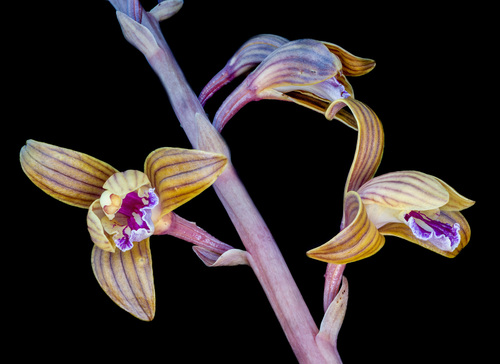


Agaves, Orchids, Irises, And Allies
asparagales
Asparagales is a massive and incredibly diverse order of monocotyledonous flowering plants that includes some of the world's most beloved and economically vital flora. Spanning from delicate, intricate orchids and vibrant irises to resilient agaves and hardy yuccas, this group showcases a breathtaking variety of survival strategies. Many members are characterized by geophytic habits, relying on underground storage organs like bulbs, corms, or rhizomes to survive harsh seasons. Beyond their sheer beauty, they play indispensable roles in human culture and agriculture; this order gives us essential culinary staples like onions, garlic, and asparagus, as well as tequila from agaves and countless ornamental plants that grace gardens worldwide.
Lebensraum: Found globally in environments ranging from arid deserts and tropical rainforests to temperate meadows and alpine slopes.
This vast group displays immense morphological diversity, ranging from tiny, ephemeral forest herbs to massive, tree-like desert succulents. They typically feature parallel-veined leaves that are often strap-shaped or fleshy, arranged in basal rosettes or along stems. Flowers are frequently highly symmetrical and showy, containing parts in multiples of three, with fused tepals forming trumpet or star shapes, and colors ranging from brilliant blues and purples in irises to dazzling, complex mimicry patterns in orchids.
Kategorie
PflanzenSeltenheit
Common
Gefahr
1/5 · Sehr gering
Snaps
Mach den ersten Snap!
Saffron, the world's most expensive spice by weight, is harvested from the tri-lobed stigmas of Crocus sativus, a member of the iris family within Asparagales.
Some agave plants grow for up to 30 years before producing a single, massive flower spike that can reach over 9 meters tall, after which the main plant dies.
The family Orchidaceae, which belongs to this order, is one of the two largest families of flowering plants, containing over 28,000 accepted species.
Many species use bulbs, corms, or tubers to store water and nutrients, enabling them to survive wildfires, severe droughts, and freezing winters.
Orchids within this order employ complex visual, tactile, and chemical mimicry to deceive specific insect pollinators into helping them reproduce.
Arid-dwelling members like agaves use Crassulacean Acid Metabolism to open their stomata only at night, drastically reducing precious water loss.
As photosynthetic plants, members of this order manufacture their own food using sunlight, water, carbon dioxide, and essential soil nutrients.
Leptonycteris yerbabuenae
Serves as a primary pollinator for night-blooming agaves like Agave tequilana.
Apis mellifera
Pollinates many Asparagales flowers, including wild onions and ornamental irises, in exchange for nectar.
Spodoptera frugiperda
Feeds voraciously on the leaves of onions, garlic, and other cultivated monocots in this order.
Für dieses Objekt sind noch keine Merkmal-Badges vergeben.
Noch keine Alternativnamen vorhanden.
Sammlungen für dieses Objekt erscheinen hier, wenn weitere Themen hinzugefügt werden.
Gefahr
1/5 · Sehr gering
Noch keine besonderen Sicherheitshinweise.
Der einfachste Weg, Agaves, Orchids, Irises, And Allies zu bestimmen, ist die Verwendung der Naturführer-App Snappit.
1+ cm
0.001+ kg
1+ Jahre
As photosynthetic plants, members of this order manufacture their own food using sunlight, water, carbon dioxide, and essential soil nutrients.
Found globally in environments ranging from arid deserts and tropical rainforests to temperate meadows and alpine slopes.
Zoome hinein, um Cluster aufzulösen und zu sehen, wo dieses Objekt fotografiert wurde.
Neueste Snaps erscheinen hier, wenn neue Beobachtungen hinzukommen.








_on_a_tree_in_the_Cashew_Road_vicinity%2C_Singapore_-_20101112.jpg&width=800)







.jpg&width=800)


