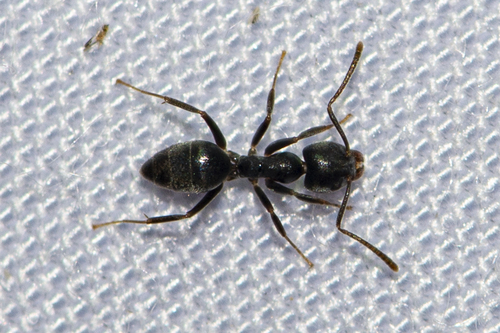


Albipes-Group Pale-Footed Ants
technomyrmex albipes
The Albipes-Group Pale-Footed Ants, scientifically known as Technomyrmex albipes, represent a widespread and highly adaptable group of ants recognized for their distinctive appearance and significant ecological impact. Originating from Southeast Asia, these ants have become a highly successful invasive species across tropical and subtropical regions globally, often aided by human commerce. They are known for their flexible nesting habits and ability to form large, multi-queen colonies, which contributes to their dominance in new environments. While small in size, their collective behavior and mutualistic relationships with sap-sucking insects make them important, and sometimes detrimental, components of various ecosystems.
Lebensraum: Found in a wide range of habitats, including forests, disturbed areas, agricultural lands, and urban environments, often nesting under bark, in leaf litter, rotten wood, or soil.
These small ants typically measure between 2 to 3 millimeters in length. Their bodies are generally dark brown to black, providing a stark contrast to their most distinguishing feature: the pale white or yellowish tarsi (the very ends of their legs), giving them their common 'pale-footed' name. They have a sleek, slender build and lack the constriction between the first two segments of the gaster (abdomen) that is characteristic of some other ant species. Worker ants are wingless, while reproductive females (queens) and males possess wings before mating.
Kategorie
InsektenSeltenheit
Common
Gefahr
1/5 · Sehr gering
Snaps
Mach den ersten Snap!
The 'Albipes' in their scientific name refers to 'white feet,' highlighting their most distinctive visual trait.
Their ability to form 'supercolonies' where multiple nests function as a single cooperative unit greatly enhances their invasive success and ecological dominance.
They are considered significant agricultural pests in many regions due to their tendency to protect sap-sucking insects like mealybugs and scale insects, which can severely damage crops.
Unlike many ant species, they are tolerant of nests with multiple queens (polygynous colonies), which allows for rapid colony growth and resilience.
Albipes-Group Pale-Footed Ants form mutualistic relationships with sap-sucking insects like aphids and scale insects, protecting them from predators in exchange for their sugary excretions (honeydew), which is a vital food source for the colony.
When a scout ant discovers a new food source or nest site, it guides other nestmates to it through a behavior called tandem running. One ant leads while the follower maintains antennal contact, tapping the leader's gaster.
These ants can establish massive supercolonies, characterized by multiple queens and interconnected nests that do not show aggression towards each other, enabling rapid expansion and effective resource exploitation across large areas.
The diet of Albipes-Group Pale-Footed Ants is diverse, primarily consisting of honeydew collected from sap-sucking insects and supplemented with various small arthropods and sugary substances.
Aphidoidea spp.
Mutualistic relationship for sugary excretions.
Various Formicidae spp.
Competition for resources and nesting sites.
Araneae spp.
Preyed upon by various generalist insectivores.
Citrus spp.
Provides habitat and indirect food source through sap-sucking insects.
Für dieses Objekt sind noch keine Merkmal-Badges vergeben.
Noch keine Alternativnamen vorhanden.
Sammlungen für dieses Objekt erscheinen hier, wenn weitere Themen hinzugefügt werden.
Gefahr
1/5 · Sehr gering
Noch keine besonderen Sicherheitshinweise.
Der einfachste Weg, Albipes-Group Pale-Footed Ants zu bestimmen, ist die Verwendung der Naturführer-App Snappit.
0 cm
0 kg
0-3 Jahre
The diet of Albipes-Group Pale-Footed Ants is diverse, primarily consisting of honeydew collected from sap-sucking insects and supplemented with various small arthropods and sugary substances.
Found in a wide range of habitats, including forests, disturbed areas, agricultural lands, and urban environments, often nesting under bark, in leaf litter, rotten wood, or soil.
Foraging
Zoome hinein, um Cluster aufzulösen und zu sehen, wo dieses Objekt fotografiert wurde.
Neueste Snaps erscheinen hier, wenn neue Beobachtungen hinzukommen.











