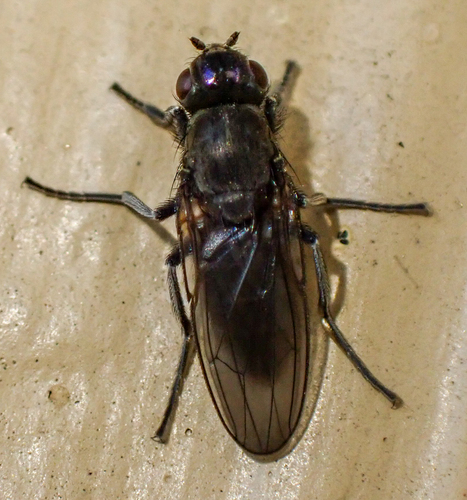


Alkali Fly
cirrula hians
The alkali fly (Cirrula hians) is a remarkable shore fly species famous for its ability to thrive in extremely harsh hypersaline and highly alkaline environments, such as Mono Lake in California. Unaffected by the intense chemical conditions that would kill most other animals, these tiny flies occur in massive, dark ribbons along the shoreline, numbering in the millions. They play a critical ecological role as a primary food source for hundreds of thousands of migratory birds that nest or rest in these unique saline lake ecosystems. Historically, they were also a highly prized food source (Kutsavi) for the local Kuzadika'a Native American people, who harvested the pupae.
Lebensraum: Found on the margins of highly saline, alkaline lakes and mineral springs, particularly where tufa towers and benthic algae are present.
Alkali flies are small, robust flies measuring about 4 to 7 millimeters in length, with a dark, metallic bronze-brown to greenish-black coloration. They have large, reddish-brown compound eyes and short, stubby antennae. Their wings are clear or slightly dusky and are folded flat over their backs when at rest. A key defining feature is their dense covering of fine, water-repellent hairs, which gives them a silvery, shimmering appearance when submerged underwater inside their self-created air bubbles.
Kategorie
InsektenSeltenheit
Common
Gefahr
1/5 · Sehr gering
Snaps
Mach den ersten Snap!
An alkali fly's hairy body is so hydrophobic that it requires physical effort for the fly to force itself underwater against the buoyant force of its protective air bubble.
Mark Twain once wrote about the alkali flies of Mono Lake, marveling at how they could be held underwater and emerge completely dry.
The Kutzadika'a people, a band of Northern Paiute, traditionally harvested the protein-rich pupae of these flies as a vital seasonal food source called kutsavi.
They utilize dense, hydrophobic hairs to trap a protective bubble of atmospheric air around their bodies, allowing them to crawl underwater to feed and lay eggs.
Possess highly specialized carbonate-excreting organs that allow them to process and survive extreme concentrations of salt and alkali.
Specialized clawed feet allow adults to cling securely to underwater rocks and tufa structures to graze on benthic algae despite their natural buoyancy.
Adults and larvae feed primarily on benthic microscopic algae and cyanobacteria that coat underwater rocks.
Larus californicus
Gulls feast on adult flies and pupae along the lake shorelines.
Phalaropus tricolor
These migratory shorebirds consume massive quantities of alkali flies to fuel their long migration.
Podiceps nigricollis
Eared grebes dive to feed on alkali fly larvae and pupae.
Für dieses Objekt sind noch keine Merkmal-Badges vergeben.
Noch keine Alternativnamen vorhanden.
Sammlungen für dieses Objekt erscheinen hier, wenn weitere Themen hinzugefügt werden.
Gefahr
1/5 · Sehr gering
Noch keine besonderen Sicherheitshinweise.
Der einfachste Weg, Alkali Fly zu bestimmen, ist die Verwendung der Naturführer-App Snappit.
0 cm
0-1 cm
0.000002-0.000005 kg
0 Jahre
8 km/h
Adults and larvae feed primarily on benthic microscopic algae and cyanobacteria that coat underwater rocks.
Found on the margins of highly saline, alkaline lakes and mineral springs, particularly where tufa towers and benthic algae are present.
Zoome hinein, um Cluster aufzulösen und zu sehen, wo dieses Objekt fotografiert wurde.
Neueste Snaps erscheinen hier, wenn neue Beobachtungen hinzukommen.

















