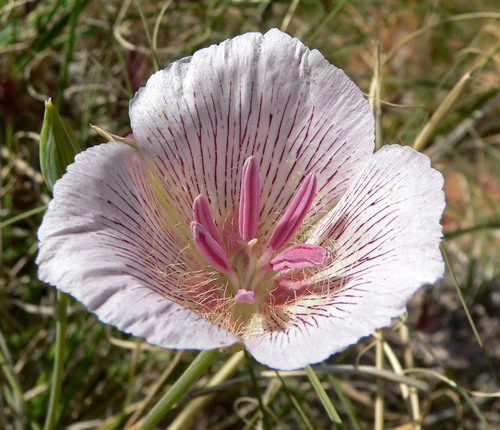


Alkali Mariposa Lily
calochortus striatus
The Alkali Mariposa Lily is a stunning and highly specialized perennial wildflower native to the arid environments of the southwestern United States. Thriving in the harsh, salty soils of desert springs and alkali meadows, this resilient plant stands as a testament to botanical adaptation. Unlike many other desert wildflowers that blanket the landscape indiscriminately, this lily is a rare treasure, localized to specific moisture-rich pockets within Mojave Desert ecosystems. Its presence indicates a vital, delicate water source beneath the arid surface.
Lebensraum: Found in moist alkaline meadows, desert springs, and seasonally wet clay sinks within arid regions.
This delicate wildflower features upright stems growing between 10 and 45 centimeters tall, rising from an underground bulb. It is easily distinguished by its showy, bell-shaped flowers which are white to pale lavender. The petals are adorned with striking, parallel magenta or purple veins and a patch of yellow hairs near the base. The narrow, grass-like leaves are primarily basal, often drying up by the time the exquisite flowers open in late spring.
Kategorie
PflanzenSeltenheit
Common
Gefahr
1/5 · Sehr gering
Snaps
Mach den ersten Snap!
Its purple veins act as natural roadmaps for bees, pointing them directly to the nectar glands at the petal bases.
The name Calochortus is derived from Greek, meaning 'beautiful grass', in reference to its grassy leaves and elegant flowers.
This species is a crucial indicator of healthy underground aquifers and spring systems in the otherwise parched Mojave Desert.
It successfully thrives in highly saline and alkaline soils that would dehydrate or poison most other plant species.
The plant can remain completely dormant underground as a bulb during extremely dry years, waiting for adequate seasonal rains to bloom.
Its prominent purple stripes act as visual runways under ultraviolet light, guiding pollinators directly to the flower's reproductive center.
As a photosynthetic plant, it manufactures its own nutrients using sunlight, water, carbon dioxide, and essential soil minerals.
Lasioglossum
Provides nectar and pollen while relying on the insect for pollination services.
Xerospermophilus mohavensis
Its underground bulbs and green foliage are occasionally eaten by desert rodents during food shortages.
Distichlis spicata
Competes for space and precious moisture in rare, moist desert seep environments.
Für dieses Objekt sind noch keine Merkmal-Badges vergeben.
Noch keine Alternativnamen vorhanden.
Sammlungen für dieses Objekt erscheinen hier, wenn weitere Themen hinzugefügt werden.
Gefahr
1/5 · Sehr gering
Noch keine besonderen Sicherheitshinweise.
Der einfachste Weg, Alkali Mariposa Lily zu bestimmen, ist die Verwendung der Naturführer-App Snappit.
10-45 cm
5-15 Jahre
As a photosynthetic plant, it manufactures its own nutrients using sunlight, water, carbon dioxide, and essential soil minerals.
Found in moist alkaline meadows, desert springs, and seasonally wet clay sinks within arid regions.
Zoome hinein, um Cluster aufzulösen und zu sehen, wo dieses Objekt fotografiert wurde.
Neueste Snaps erscheinen hier, wenn neue Beobachtungen hinzukommen.









.JPG&width=800)








