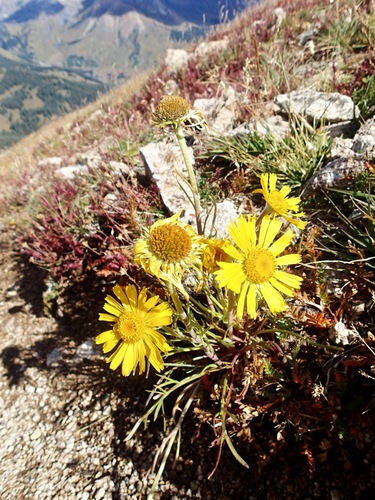


Alpine Sunflower
hymenoxys grandiflora
The Alpine Sunflower, also known as 'Old-Man-of-the-Mountain,' is an iconic and remarkably resilient wildflower native to the high-altitude tundras of North America's Rocky Mountains. Living in one of the harshest environments on Earth, this slow-growing perennial spends several years accumulating nutrients in a harsh, cold climate before producing a single, spectacularly large yellow bloom. This plant is celebrated by hikers and botanists alike for its cheerful appearance amidst barren rocky slopes and its fascinating adaptation of always facing eastward to catch the first warming rays of the morning sun.
Lebensraum: Found on gravelly alpine tundras, rocky ridges, and talus slopes high above the treeline.
This low-growing wildflower features a single, disproportionately large daisy-like flower head measuring up to 8 centimeters across, boasting bright golden-yellow ray petals and a darker yellow central disc. The short, sturdy stem and deeply divided, lobed leaves are densely covered in thick, white, woolly hairs that give the plant a silvery-green or fuzzy appearance. It typically grows close to the ground, reaching heights of only 8 to 30 centimeters to avoid the punishing alpine winds.
Kategorie
PflanzenSeltenheit
Common
Gefahr
1/5 · Sehr gering
Snaps
Mach den ersten Snap!
Because the flower heads always face east, lost hikers in the Rocky Mountains can actually use them as a natural compass.
Its fuzzy, bearded look earned it the popular local nickname 'Old-Man-of-the-Mountain' among mountaineers.
The plant is monocarpic, meaning it grows for up to 10 years, flowers just once, and then dies immediately after setting its seeds.
The developing flower buds track the sun, but upon opening, they permanently face east to capture the morning sun, maximizing warmth to attract chilled alpine pollinators.
Dense, felt-like white hairs cover the stems and leaves, creating a micro-boundary layer that insulates the plant from freezing temperatures and blocks intense UV radiation.
The plant conserves energy for up to a decade in a harsh climate to produce a single massive, successful reproductive event before dying.
The Alpine Sunflower is a photosynthetic organism that generates its own energy from sunlight, water, carbon dioxide, and essential soil minerals.
Bombus balteatus
Relies heavily on high-altitude bumblebees for pollination to successfully fertilize its seeds during its single blooming season.
Ochotona princeps
Leaves and flowers are collected, dried, and stored in haypiles as a vital winter food source by small alpine mammals.
Silene acaulis
Competes for limited soil moisture, nutrients, and space with other low-growing alpine plants in gravelly soils.
Für dieses Objekt sind noch keine Merkmal-Badges vergeben.
Noch keine Alternativnamen vorhanden.
Sammlungen für dieses Objekt erscheinen hier, wenn weitere Themen hinzugefügt werden.
Gefahr
1/5 · Sehr gering
Noch keine besonderen Sicherheitshinweise.
Der einfachste Weg, Alpine Sunflower zu bestimmen, ist die Verwendung der Naturführer-App Snappit.
8+ cm
0.005+ kg
5+ Jahre
The Alpine Sunflower is a photosynthetic organism that generates its own energy from sunlight, water, carbon dioxide, and essential soil minerals.
Found on gravelly alpine tundras, rocky ridges, and talus slopes high above the treeline.
Zoome hinein, um Cluster aufzulösen und zu sehen, wo dieses Objekt fotografiert wurde.
Neueste Snaps erscheinen hier, wenn neue Beobachtungen hinzukommen.









%2C_%CE%95%CF%80%CF%84%CE%B1%CF%80%CF%8D%CF%81%CE%B3%CE%B9%CE%BF%2C_%CE%98%CE%B5%CF%83%CF%83%CE%B1%CE%BB%CE%BF%CE%BD%CE%AF%CE%BA%CE%B7%2C_05-06-2021.jpg&width=800)










