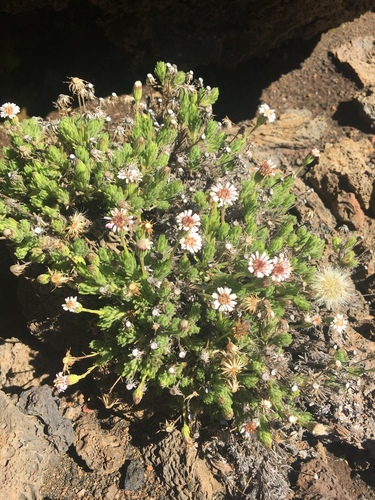


Alpine Tetramolopium
tetramolopium humile
The Alpine Tetramolopium (Tetramolopium humile) is a remarkably resilient flowering plant endemic to the high-altitude volcanic landscapes of the Hawaiian Islands. This species has evolved unique adaptations to thrive in harsh, exposed environments characterized by extreme temperature fluctuations, strong winds, and nutrient-poor soils. It plays a critical role in these delicate ecosystems, contributing to biodiversity and acting as a pioneer species in relatively barren areas. Its ability to colonize and persist in such challenging conditions makes it a fascinating subject for botanical study and a testament to evolutionary adaptation, highlighting the incredible diversity found even in isolated, high-elevation habitats.
Lebensraum: Found exclusively in high-altitude alpine and subalpine volcanic deserts, cinder cones, and rocky lava fields on the Hawaiian Islands.
This low-growing subshrub or cushion plant typically forms compact mats, usually reaching 5 to 30 centimeters in height. Its small, linear leaves are often densely packed and may have a grayish-green hue, helping to minimize water loss. The plant produces delicate, daisy-like flower heads, which are usually white or pale lavender with a yellow center, blooming during the warmer months. These flowers are relatively small, typically less than 1.5 cm in diameter, and are held on short stalks above the foliage.
Kategorie
PflanzenSeltenheit
Common
Gefahr
1/5 · Sehr gering
Snaps
Mach den ersten Snap!
Alpine Tetramolopium is one of the few plant species capable of surviving and flowering at elevations over 3,000 meters on Hawaiian volcanoes.
Its compact, cushion-like growth form helps protect it from the intense winds and extreme temperature fluctuations experienced in its high-altitude home.
Seeds of this plant can remain viable in the soil for extended periods, allowing it to re-establish after disturbances like volcanic activity or severe weather events.
The genus Tetramolopium is part of the 'silversword alliance', a group of highly specialized plants endemic to Hawaii, known for their incredible adaptive radiation.
It possesses physiological adaptations that allow it to withstand freezing temperatures and harsh winds common in its high-elevation habitat, including a compact growth form that traps heat.
The plant is adapted to high levels of ultraviolet radiation at altitude, likely through protective compounds in its foliage and a low-lying growth habit.
Its small, often hairy or waxy leaves and extensive root system enable it to efficiently capture and retain moisture from occasional rainfall or mist in arid volcanic soils.
As an autotrophic plant, the Alpine Tetramolopium produces its own food through photosynthesis, converting sunlight, carbon dioxide, and water into sugars.
Hylaeus spp.
Pollinator for flower reproduction.
Lycosa spp. (native Hawaiian)
Provides habitat and a microclimate for small native invertebrates.
Argyroxiphium sandwicense subsp. sandwicense
Competes for light, water, and nutrients in the harsh alpine environment.
Various fungal species
Essential for nutrient cycling and soil health in volcanic soils.
Für dieses Objekt sind noch keine Merkmal-Badges vergeben.
Noch keine Alternativnamen vorhanden.
Sammlungen für dieses Objekt erscheinen hier, wenn weitere Themen hinzugefügt werden.
Gefahr
1/5 · Sehr gering
Noch keine besonderen Sicherheitshinweise.
Der einfachste Weg, Alpine Tetramolopium zu bestimmen, ist die Verwendung der Naturführer-App Snappit.
5-30 cm
0.005-0.05 kg
5-15 Jahre
As an autotrophic plant, the Alpine Tetramolopium produces its own food through photosynthesis, converting sunlight, carbon dioxide, and water into sugars.
Found exclusively in high-altitude alpine and subalpine volcanic deserts, cinder cones, and rocky lava fields on the Hawaiian Islands.
Photosynthesis (absorption And Fixation)
100-500
Zoome hinein, um Cluster aufzulösen und zu sehen, wo dieses Objekt fotografiert wurde.
Neueste Snaps erscheinen hier, wenn neue Beobachtungen hinzukommen.




















