

American Fly-Honeysuckle
lonicera canadensis
The American Fly-Honeysuckle is a charming deciduous shrub native to the cool, moist forests of eastern North America. Reaching modest heights in the forest understory, it is one of the earliest shrubs to leaf out and bloom in the spring, offering vital early-season resources for emerging pollinators. Its pairs of delicate, trumpet-like yellow flowers hang gracefully beneath bright green leaves, eventually developing into distinctive twin red berries. Unlike its invasive counterparts, this native honeysuckle grows in harmony with its ecosystem, acting as a gentle and beneficial member of forest communities rather than overtaking them. It provides food and shelter for various wildlife, from hummingbirds seeking nectar to songbirds eating its summer fruit.
Lebensraum: Found in cool, moist, deciduous or mixed coniferous forests, often on rocky slopes, ledges, or near stream banks.
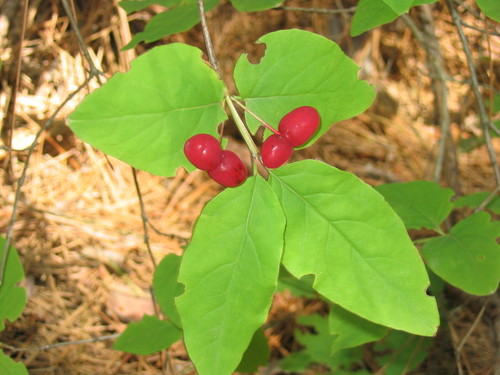
The American Fly-Honeysuckle is a straggling to upright shrub growing 100 to 150 centimeters tall, characterized by slender, opposite branching and solid white stem pith. Its leaves are simple, egg-shaped, and light green with fine, hairy margins. In spring, it produces pairs of dangling, pale yellow, bell- or trumpet-shaped flowers that arise from the leaf axils. By mid-summer, these flowers mature into distinctive paired, bright red, egg-shaped berries that are joined at the base, looking like tiny twin droplets hanging beneath the foliage.
Kategorie
PflanzenSeltenheit
Common
Gefahr
1/5 · Sehr gering
Snaps
Mach den ersten Snap!
The common name 'Fly-Honeysuckle' comes from the shape and position of its twin flowers, which hang in pairs resembling small insect wings.
Unlike invasive honeysuckles in North America, the American Fly-Honeysuckle has a solid white center in its twigs rather than a hollow brown core.
While the paired red berries are a favorite snack for forest birds, they are mildly toxic to humans and should not be eaten.
Initiates leaf growth and flowering extremely early in spring, capturing sunlight before the taller forest canopy closes.
Produces paired, bright red berries that contrast sharply with green foliage, highly visible to passing avian seed dispersers.
Optimizes photosystem efficiency to survive and thrive under dense forest canopies with minimal direct sunlight.
As a plant, the American Fly-Honeysuckle produces its own energy through photosynthesis, using sunlight, water, carbon dioxide, and soil minerals.
Archilochus colubris
Pollinates the flowers in early spring in search of nectar.
Turdus migratorius
Feeds on the bright red berries and subsequently disperses the seeds.
Bombus vagans
Visits the early-season flowers for nectar and pollen, acting as an essential pollinator.
Für dieses Objekt sind noch keine Merkmal-Badges vergeben.
Noch keine Alternativnamen vorhanden.
Sammlungen für dieses Objekt erscheinen hier, wenn weitere Themen hinzugefügt werden.
Gefahr
1/5 · Sehr gering
Noch keine besonderen Sicherheitshinweise.
Der einfachste Weg, American Fly-Honeysuckle zu bestimmen, ist die Verwendung der Naturführer-App Snappit.
100-150 cm
10-30 Jahre
As a plant, the American Fly-Honeysuckle produces its own energy through photosynthesis, using sunlight, water, carbon dioxide, and soil minerals.
Found in cool, moist, deciduous or mixed coniferous forests, often on rocky slopes, ledges, or near stream banks.
Zoome hinein, um Cluster aufzulösen und zu sehen, wo dieses Objekt fotografiert wurde.
Neueste Snaps erscheinen hier, wenn neue Beobachtungen hinzukommen.




_on_Mixed_Grass_Prairie_of_Lacreek_NWR_(13918328442).jpg&width=800)




_3759.JPG&width=800)








