

American Hog-Peanut
amphicarpaea bracteata
The American Hog-Peanut is a fascinating native climbing annual vine in the legume family, widely distributed across the rich deciduous forests of eastern North America. This delicate plant is highly regarded for its unique and complex reproductive strategy known as amphicarpy, which allows it to produce two entirely different types of flowers and seeds depending on their location on the plant. Its dual seed system historically served as a critical food resource for both wildlife and Indigenous peoples, who harvested the highly nutritious underground seeds during the harsh winter months.
Lebensraum: Found in moist deciduous forests, rich woodlands, thickets, and along shaded stream banks.
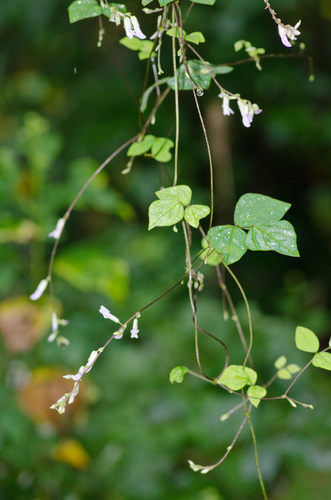
This slender, twining vine features delicate, light-green compound leaves split into three egg-shaped, pointed leaflets measuring 3 to 8 centimeters in length. In late summer, it produces dangling clusters of pale pink, light purple, or white tubular flowers about 1.5 centimeters long on its aerial stems. Meanwhile, creeping ground-level runners produce tiny, inconspicuous, bud-like flowers without petals. The aerial flowers develop into flat, hairy, multi-seeded legume pods, while the subterranean flowers produce round, single-seeded fleshy pods containing a larger dark brown nut.
Kategorie
PflanzenSeltenheit
Common
Gefahr
1/5 · Sehr gering
Snaps
Mach den ersten Snap!
Indigenous peoples and early settlers frequently raided the underground winter food caches of voles and mice to gather the edible 'peanuts' in large quantities.
Its subterranean seeds act as an ecological insurance policy, as they are larger and more likely to survive local disturbances like fire than the aerial seeds.
The plant's genus name, Amphicarpaea, comes from the Greek words for 'double' and 'fruit', describing its dual seed-bearing habit.
Produces two distinct types of flowers: showy, pollinator-dependent aerial blossoms and self-pollinating underground flowers.
Collaborates with specialized root bacteria to convert atmospheric nitrogen into rich soil nutrients.
Utilizes rapid, sensitive twining stems to climb surrounding forest vegetation and access filtered sunlight.
As a photosynthetic plant, it generates its own energy from sunlight, water, and carbon dioxide while extracting vital minerals from the soil.
Bradyrhizobium elkanii
Fixes nitrogen in root nodules through a mutualistic symbiotic relationship.
Microtus pennsylvanicus
Gathers and consumes the highly nutritious subterranean seeds during winter.
Bombus impatiens
Pollinates the showy aerial flowers while gathering nectar.
Für dieses Objekt sind noch keine Merkmal-Badges vergeben.
Noch keine Alternativnamen vorhanden.
Sammlungen für dieses Objekt erscheinen hier, wenn weitere Themen hinzugefügt werden.
Gefahr
1/5 · Sehr gering
Noch keine besonderen Sicherheitshinweise.
Der einfachste Weg, American Hog-Peanut zu bestimmen, ist die Verwendung der Naturführer-App Snappit.
30-150 cm
1 Jahre
As a photosynthetic plant, it generates its own energy from sunlight, water, and carbon dioxide while extracting vital minerals from the soil.
Found in moist deciduous forests, rich woodlands, thickets, and along shaded stream banks.
Zoome hinein, um Cluster aufzulösen und zu sehen, wo dieses Objekt fotografiert wurde.
Neueste Snaps erscheinen hier, wenn neue Beobachtungen hinzukommen.
















