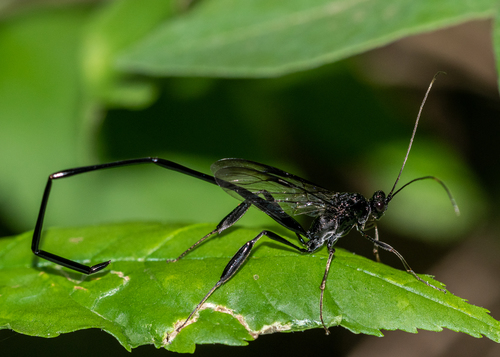


American Pelecinid Wasp
pelecinus polyturator
The American Pelecinid Wasp is an intriguing insect easily recognized by the remarkably long, slender abdomen of the female. This glossy black parasitoid wasp plays a vital ecological role by regulating populations of soil-dwelling scarab beetle larvae, particularly June beetles. While their dramatic silhouette might look intimidating, they are entirely harmless to humans and do not possess a true stinger. Instead, their elongated bodies are a marvel of evolutionary engineering designed for reaching deep underground. In North American populations, males are exceptionally rare, meaning that females typically reproduce through parthenogenesis, producing clones of themselves. Encountering one of these elegant, slow-flying wasps in a garden or forest clearing is a memorable highlight for any nature enthusiast.
Lebensraum: Found in deciduous forests, woodlands, parks, and suburban gardens where decaying organic matter and host beetle larvae are plentiful.
This wasp is characterized by a shiny, jet-black, highly polished exoskeleton. The female is distinguished by her extraordinarily long, segmented, thread-like abdomen, which is up to five times longer than the head and thorax combined and curves slightly downward. She has translucent wings with distinct dark venation, long antennae, and a total body length reaching up to 7 centimeters. Males, which are rarely seen, are much smaller (around 2.5 centimeters) and possess a shorter, club-shaped abdomen.
Kategorie
InsektenSeltenheit
Common
Gefahr
1/5 · Sehr gering
Snaps
Mach den ersten Snap!
Despite their intimidating appearance, these wasps are entirely harmless to humans and do not possess the ability to sting.
Males of this species are so rare in North America that some entomologists spend their entire careers without ever seeing one in the wild.
The female's extremely long abdomen is not a stinger; it is used solely as a flexible tube to lay eggs on underground grubs.
The female uses her highly flexible, elongated abdomen to probe deep into loose soil and leaf litter to locate host beetle grubs.
Females can reproduce through thelytokous parthenogenesis, allowing them to produce viable female offspring without needing to mate.
The wasp uses sensory organs at the tip of her abdomen to detect and deposit a single egg directly onto a buried June beetle grub.
Adult wasps feed exclusively on nectar and plant juices, while the subterranean larvae are parasitoids that consume June beetle grubs.
Altersunterschiede: Larvae are carnivorous parasitoids feeding on live beetle grubs, whereas adults transition to a purely nectar-based diet.
Phyllophaga anxia
The female wasp paralyzes and lays an egg on the larva of this beetle, which serves as food for the wasp larva.
Solidago canadensis
Adult wasps feed on the nectar of this plant during the late summer nesting season.
Für dieses Objekt sind noch keine Merkmal-Badges vergeben.
Noch keine Alternativnamen vorhanden.
Sammlungen für dieses Objekt erscheinen hier, wenn weitere Themen hinzugefügt werden.
Gefahr
1/5 · Sehr gering
Noch keine besonderen Sicherheitshinweise.
Der einfachste Weg, American Pelecinid Wasp zu bestimmen, ist die Verwendung der Naturführer-App Snappit.
5+ cm
3+ cm
0.0001+ kg
12 km/h
Adult wasps feed exclusively on nectar and plant juices, while the subterranean larvae are parasitoids that consume June beetle grubs.
Found in deciduous forests, woodlands, parks, and suburban gardens where decaying organic matter and host beetle larvae are plentiful.
Foraging
Zoome hinein, um Cluster aufzulösen und zu sehen, wo dieses Objekt fotografiert wurde.
Neueste Snaps erscheinen hier, wenn neue Beobachtungen hinzukommen.




.jpg&width=800)








.jpg&width=800)



