

Amethyst Shooting Star
primula fassettii
The Amethyst Shooting Star is a breathtaking perennial wildflower native to the unique Driftless Area of the Midwestern United States. Rising from a neat basal rosette of smooth leaves, its elegant flowering stalks bear clusters of nodding flowers that look like miniature, vibrant meteors streaking toward the earth. This species is highly specialized, preferring damp, calcareous cliffs and shady rocky outcrops where it can find cool seepages. Because of its restricted range and specific habitat requirements, finding one in bloom is a true delight for botanists and nature lovers alike. Its delicate appearance belies a hardy nature, as it has adapted perfectly to thrive on sheer, vertical rock faces where few other plants can establish a foothold.
Lebensraum: Found clinging to damp, calcareous dolomite or limestone cliffs and shaded rocky ledges, often near cold-water seeps in deciduous woodlands.
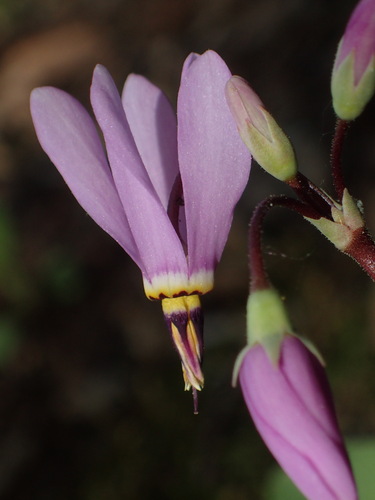
This plant is easily recognized by its distinctive flowers, which feature five reflexed, swept-back petals of deep pink to amethyst purple, exposing a downward-pointing cluster of yellow-and-purple stamens that resemble a tiny golden beak. The leaves are smooth, spatulate, and arranged in a flat, ground-hugging rosette from which a leafless stem rises to a height of 10 to 45 centimeters. Each stem holds an umbel of 1 to 10 nodding blossoms, each about 2 centimeters long, blooming from mid-spring to early summer.
Kategorie
PflanzenSeltenheit
Common
Gefahr
1/5 · Sehr gering
Snaps
Mach den ersten Snap!
Its pollen is locked away so tightly that ordinary wind or insect visits cannot dislodge it; only the powerful vibrations of a bumblebee can trigger its release.
The common name 'shooting star' perfectly describes the flower's appearance, which resembles a blazing meteor with its petals swept back like a tail of fire.
This species is a glacial relict, having survived in the unglaciated Driftless Area during the last Ice Age while surrounding areas were scraped flat.
It requires bumblebees to vibrate their flight muscles at a specific frequency to release the pollen trapped inside its tube-like anthers.
Its specialized root system can penetrate fine fissures in sheer limestone cliffs, anchoring the plant and absorbing minerals from trickling seepages.
To survive dry summer heat, the plant completely dies back to its underground rootstock shortly after releasing seeds, entering an early dormancy phase.
As a photosynthetic plant, it manufactures its own sugars using sunlight, carbon dioxide, and water, supplemented by mineral nutrients absorbed from cliffside seepages.
Bombus bimaculatus
Buzz-pollinates the flowers, vibrating them to release pollen from the tightly packed anthers.
Odocoileus virginianus
Occasionally grazes on the basal rosettes of leaves in early spring.
Für dieses Objekt sind noch keine Merkmal-Badges vergeben.
Noch keine Alternativnamen vorhanden.
Sammlungen für dieses Objekt erscheinen hier, wenn weitere Themen hinzugefügt werden.
Gefahr
1/5 · Sehr gering
Noch keine besonderen Sicherheitshinweise.
Der einfachste Weg, Amethyst Shooting Star zu bestimmen, ist die Verwendung der Naturführer-App Snappit.
10+ cm
0.01+ kg
5+ Jahre
As a photosynthetic plant, it manufactures its own sugars using sunlight, carbon dioxide, and water, supplemented by mineral nutrients absorbed from cliffside seepages.
Found clinging to damp, calcareous dolomite or limestone cliffs and shaded rocky ledges, often near cold-water seeps in deciduous woodlands.
Absorption
Zoome hinein, um Cluster aufzulösen und zu sehen, wo dieses Objekt fotografiert wurde.
Neueste Snaps erscheinen hier, wenn neue Beobachtungen hinzukommen.













.jpg&width=800)




