

Angulate And Roundshouldered Orbweavers
araneus
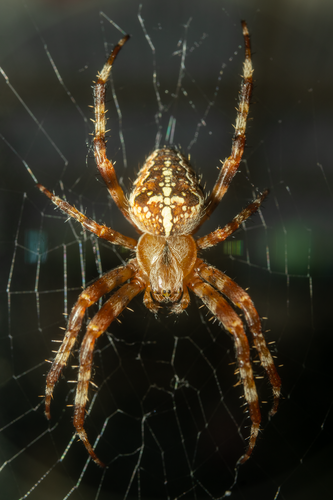
The angulate and roundshouldered orbweavers of the genus Araneus are remarkable arachnids famous for building classic, geometrically perfect spiral webs. Found globally, these spiders are essential pest controllers in forest and garden ecosystems. Their common names derive from the distinctive humps or 'shoulders' on the upper margins of their large abdomens. Primarily active at twilight and night, they showcase incredible engineering skills, spinning strong silk structures to capture flying insects. Many species within this genus consume their web daily to recycle the proteins before building a new one.
Lebensraum: Typically found in temperate forests, woodlands, gardens, and shrublands, often constructing webs between tree branches or near outdoor light fixtures.
These medium to large spiders are characterized by a bulbous, triangular abdomen with prominent shoulder humps. Their coloration is highly variable, ranging from mottled greys, browns, and tans to striking yellows and oranges, providing excellent camouflage against tree bark. Many species display a leaf-like pattern called a folium on their back. Their legs are long, robust, and heavily spined, often banded with alternating dark and light rings to disrupt their outline. Females are much larger than males, with body lengths typically between 1 and 3 centimeters.
Kategorie
InvertebrateSeltenheit
Common
Gefahr
1/5 · Sehr gering
Snaps
Mach den ersten Snap!
Spider silk from this genus is exceptionally strong, possessing a tensile strength comparable to high-grade steel of the same thickness.
The shoulder humps on angulate orbweavers help disguise them as tree bark nodules or seed pods when they tuck their legs in.
They often eat and rebuild their webs daily, a process that takes only about 30 to 45 minutes of intensive work.
They construct highly organized vertical spiral webs using both non-sticky structural silk and sticky capture silk, optimized to trap flying insects.
They systematically consume their old webs daily, digesting the silk proteins to quickly produce fresh webbing with minimal waste.
They rely on highly sensitive slit sensilla on their legs to detect minute vibrations traveling through the web, allowing them to pinpoint prey instantly.
They primarily feed on insects that fly into their spiral webs, which they wrap in silk and paralyze with venom.
Cyanocitta cristata
Predator that frequently plucks orbweavers directly from their webs.
Sceliphron caementarium
A wasp that paralyzes orbweavers to provision its mud nests for its larvae.
Musca domestica
Common flying insect pest captured and consumed by the spider.
Für dieses Objekt sind noch keine Merkmal-Badges vergeben.
Noch keine Alternativnamen vorhanden.
Sammlungen für dieses Objekt erscheinen hier, wenn weitere Themen hinzugefügt werden.
Gefahr
1/5 · Sehr gering
Noch keine besonderen Sicherheitshinweise.
Der einfachste Weg, Angulate And Roundshouldered Orbweavers zu bestimmen, ist die Verwendung der Naturführer-App Snappit.
1-3 cm
0.0001-0.005 kg
1-2 Jahre
They primarily feed on insects that fly into their spiral webs, which they wrap in silk and paralyze with venom.
Typically found in temperate forests, woodlands, gardens, and shrublands, often constructing webs between tree branches or near outdoor light fixtures.
Ambush
100-800
Zoome hinein, um Cluster aufzulösen und zu sehen, wo dieses Objekt fotografiert wurde.
Neueste Snaps erscheinen hier, wenn neue Beobachtungen hinzukommen.













