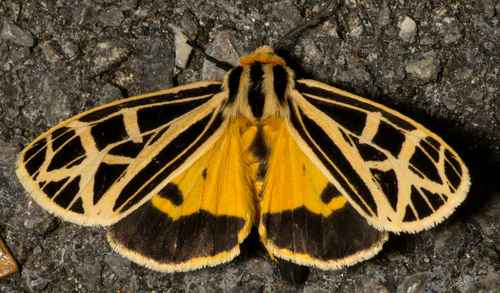


Anna Tiger Moth
apantesis anna
The Anna Tiger Moth (Apantesis anna) is a striking and intricately patterned member of the Erebidae family. Native to eastern North America, this moth is celebrated for its bold geometric shapes and contrasting color palette. It undergoes a complete metamorphosis, with its woolly, resilient caterpillar stage eventually transforming into an eye-catching adult. Equipped with advanced sensory mechanisms, the moth is highly adapted to navigate the threats of the nocturnal world, making it a fascinating subject for insect enthusiasts and researchers alike.
Lebensraum: Typically found in damp meadows, open woodlands, forest edges, and old fields where herbaceous host plants are abundant.
The adult Anna Tiger Moth features a wingspan of 4.0 to 5.2 cm. Its forewings are predominantly dark brown or black, intersected by a distinct grid of pale cream or light-yellow lines. The hindwings provide a vibrant contrast, displaying a bright yellow to orange hue adorned with thick black borders and large black spots. Its thorax is black with prominent cream stripes, while the abdomen is yellow-orange with a central row of black spots, serving as a bright warning to potential predators.
Kategorie
InsektenSeltenheit
Common
Gefahr
1/5 · Sehr gering
Snaps
Mach den ersten Snap!
Its caterpillar is covered in stiff, dense hairs that irritate the mouths of birds and can cause mild skin irritation to humans who handle them.
The bright yellow underwings of the Anna Tiger Moth act as a flash defense, startling predators when the moth suddenly takes flight.
They belong to a group of moths capable of complex acoustic mimicry, mimicking the warning sounds of other, even more toxic moth species.
Uses specialized tymbal organs on its thorax to emit high-frequency clicks that jam bat echolocation or warn them of the moth's toxicity.
As a caterpillar, it consumes and stores toxic alkaloids from host plants, rendering both larvae and adults highly unpalatable to predators.
The caterpillars can survive freezing winter temperatures by producing natural cryoprotectants in their blood to prevent internal ice damage.
Caterpillars feed on a variety of low-growing herbaceous plants and weeds, while adult moths have reduced mouthparts and feed minimally, if at all.
Altersunterschiede: Larvae are voracious foliage grazers, whereas adults primarily survive on fat reserves accumulated during the caterpillar stage.
Plantago major
The caterpillar utilizes this common lawn weed as a primary host plant for nutrition and chemical defenses.
Eptesicus fuscus
An active nocturnal predator that attempts to hunt the adult moths, though often deterred by ultrasonic clicks.
Taraxacum officinale
The larvae frequently graze on the leaves of this abundant herbaceous plant in fields and meadows.
Für dieses Objekt sind noch keine Merkmal-Badges vergeben.
Noch keine Alternativnamen vorhanden.
Sammlungen für dieses Objekt erscheinen hier, wenn weitere Themen hinzugefügt werden.
Gefahr
1/5 · Sehr gering
Noch keine besonderen Sicherheitshinweise.
Der einfachste Weg, Anna Tiger Moth zu bestimmen, ist die Verwendung der Naturführer-App Snappit.
2-3 cm
4-6 cm
0.0001-0.0005 kg
1 Jahre
12 km/h
Caterpillars feed on a variety of low-growing herbaceous plants and weeds, while adult moths have reduced mouthparts and feed minimally, if at all.
Typically found in damp meadows, open woodlands, forest edges, and old fields where herbaceous host plants are abundant.
Zoome hinein, um Cluster aufzulösen und zu sehen, wo dieses Objekt fotografiert wurde.
Neueste Snaps erscheinen hier, wenn neue Beobachtungen hinzukommen.




.jpg&width=800)









