

Arabian Jasmine
jasminum sambac
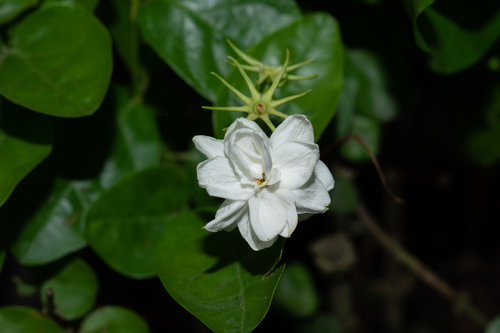
Arabian Jasmine (Jasminum sambac) is a captivating evergreen shrub or climbing vine famous worldwide for its intensely sweet, exotic fragrance. Originating in southern Asia, it has been cultivated for centuries for its beautiful white blossoms, which are central to various cultural ceremonies, lei making, and flavoring jasmine tea. Known as Sampaguita in the Philippines and Melati Putih in Indonesia, it holds national significance in several countries, symbolizing purity, love, and devotion. This plant thrives in warm, tropical climates and produces flowers that open at night and close in the morning, releasing their strongest scent under the stars.
Lebensraum: Typically found in tropical and subtropical regions, thriving in warm, humid forests, open shrublands, and cultivated gardens with moist, well-draining soil.
Arabian Jasmine grows as a sprawling shrub or woody vine reaching heights of 50 to 300 cm. It features glossy, dark green, ovate leaves arranged in opposite pairs or in whorls of three, measuring about 4 to 12 cm long. The star-shaped flowers are pure white, turning a delicate pinkish-purple as they fade. They typically bloom in small clusters of 3 to 12 at the ends of branches, with each blossom possessing a tubular calyx and multiple layers of rounded petals.
Kategorie
PflanzenSeltenheit
Common
Gefahr
1/5 · Sehr gering
Snaps
Mach den ersten Snap!
Arabian Jasmine is the national flower of both the Philippines, where it is known as Sampaguita, and Indonesia, where it is known as Melati Putih.
Despite its common name Arabian Jasmine, the species is actually native to South and Southeast Asia, not Arabia, but was introduced to the Middle East along ancient trade routes.
The flowers are used to flavor traditional Chinese Jasmine Tea, where tea leaves are layered with fresh jasmine blossoms repeatedly to absorb their delicate aroma.
Releases a highly concentrated, sweet fragrance primarily during the night to attract nocturnal pollinators like hawk moths.
Utilizes flexible, woody stems to scramble over surrounding vegetation, maximizing its access to sunlight in dense forest understories.
In warm climates, it possesses the ability to bloom year-round, continuously producing new buds in successive waves.
As a photoautotrophic plant, Arabian Jasmine produces its own organic nutrients through photosynthesis using sunlight, water, and carbon dioxide, while absorbing essential minerals from the soil.
Daphnis nerii
Nectar-seeking adult moths pollinate the nocturnal blooms.
Hendecasis duplifascialis
Larvae feed on the flower buds and young shoots of the jasmine, damaging the blooms.
Tetranychus urticae
Feeds on leaf sap, causing yellow stippling and webbing on the foliage.
Für dieses Objekt sind noch keine Merkmal-Badges vergeben.
Noch keine Alternativnamen vorhanden.
Sammlungen für dieses Objekt erscheinen hier, wenn weitere Themen hinzugefügt werden.
Gefahr
1/5 · Sehr gering
Noch keine besonderen Sicherheitshinweise.
Der einfachste Weg, Arabian Jasmine zu bestimmen, ist die Verwendung der Naturführer-App Snappit.
50-300 cm
10-50 Jahre
As a photoautotrophic plant, Arabian Jasmine produces its own organic nutrients through photosynthesis using sunlight, water, and carbon dioxide, while absorbing essential minerals from the soil.
Typically found in tropical and subtropical regions, thriving in warm, humid forests, open shrublands, and cultivated gardens with moist, well-draining soil.
Zoome hinein, um Cluster aufzulösen und zu sehen, wo dieses Objekt fotografiert wurde.
Neueste Snaps erscheinen hier, wenn neue Beobachtungen hinzukommen.