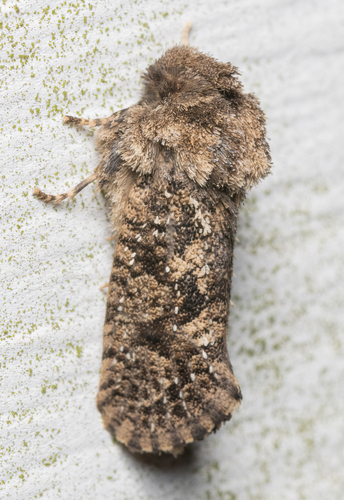


Arcane Grass Tubeworm Moth
acrolophus arcanella
Meet the Arcane Grass Tubeworm Moth, an intriguing little nocturnal insect that spends much of its life hidden right beneath our feet. While the adults are modest, fuzzy brown fliers often seen fluttering near porch lights on warm summer nights, the caterpillars are subterranean master builders. These larvae construct elaborate, silk-lined tubes in the soil, which serve as protective bunkers while they feed on grass roots and decaying plant material. This hidden lifestyle makes them an essential, yet largely unseen, component of grassland and lawn ecosystems throughout North America. Despite their secretive larval phase, adults emerge in mid-to-late summer, adding to the rich biodiversity of nighttime insects. They are fascinating to observe up close, showcasing remarkable evolutionary adaptations that allow them to thrive in close proximity to human habitats, bridging the gap between wild grasslands and urban lawns.
Lebensraum: Found in grassy areas, including lawns, meadows, pastures, and open woodlands where larval host plants are abundant.
Adults are small, drab moths with a wingspan of roughly 2.2 to 2.8 cm, featuring forewings mottled in shades of earthy brown, tan, and grey that mimic bark or dried leaves. Their most defining visual characteristic is the dense, brush-like tuft of hairs on their head and the exceptionally large, upturned labial palpi of the males, which curve backward over the head like a tiny, furry crest. When at rest, they hold their wings tightly tented over their bodies, creating a narrow, cylindrical silhouette that blends seamlessly into grass stems.
Kategorie
InsektenSeltenheit
Common
Gefahr
1/5 · Sehr gering
Snaps
Mach den ersten Snap!
If disturbed during the day, adult moths will often drop to the ground and play dead, perfectly blending with dry grass clippings.
The larval tube homes of this moth can extend several inches underground, acting as a miniature silk highway through the soil.
The prominent tuft on the adult moth's head has earned them the nickname of having a 'furry mohawk' among insect enthusiasts.
Larvae weave protective, vertical silken tubes deep in the soil and grass roots to shield themselves from predators and moisture loss.
Adults mimic dry twigs or grass debris when resting, holding their wings tightly wrapped around their body to evade detection by day.
The males possess elongated, heavily scaled labial palpi that assist in sensing female pheromones across grassy fields.
Larvae feed underground on grass roots and decaying organic matter, while adults have vestigial mouthparts and generally do not feed, living off larval fat reserves.
Altersunterschiede: Larvae feed actively on subterranean plant roots and detritus, whereas the short-lived adults do not feed at all.
Poa pratensis
The larvae feed on the roots of Kentucky Bluegrass, occasionally damaging turfgrass in high densities.
Anaxyrus americanus
Adult moths are a frequent prey source for nocturnal insectivores like the Eastern American Toad.
Ophion luteus
Larval stages are sometimes parasitized by specialized ichneumonid wasps seeking hosts in the soil.
Für dieses Objekt sind noch keine Merkmal-Badges vergeben.
Noch keine Alternativnamen vorhanden.
Sammlungen für dieses Objekt erscheinen hier, wenn weitere Themen hinzugefügt werden.
Gefahr
1/5 · Sehr gering
Noch keine besonderen Sicherheitshinweise.
Der einfachste Weg, Arcane Grass Tubeworm Moth zu bestimmen, ist die Verwendung der Naturführer-App Snappit.
1+ cm
2+ cm
0.00005+ kg
1+ Jahre
8 km/h
Larvae feed underground on grass roots and decaying organic matter, while adults have vestigial mouthparts and generally do not feed, living off larval fat reserves.
Found in grassy areas, including lawns, meadows, pastures, and open woodlands where larval host plants are abundant.
Zoome hinein, um Cluster aufzulösen und zu sehen, wo dieses Objekt fotografiert wurde.
Neueste Snaps erscheinen hier, wenn neue Beobachtungen hinzukommen.