

Arizona Gray Squirrel
sciurus arizonensis
The Arizona Gray Squirrel is a charming and elusive resident of the montane riparian canyons of the southwestern United States and northwestern Mexico. Unlike its more urban cousin, the Eastern Gray Squirrel, this species is closely tied to deep, wooded canyons featuring walnut, sycamore, oak, and pine trees. Known for its quiet and wary demeanor, it blends seamlessly into the rocky and forested terrain, often remaining undetected unless heard rustling in the canopy or making its raspy barking calls. This squirrel plays an essential role in its unique ecosystem by dispersing seeds and nuts, helping to regenerate the diverse tree species of the desert canyons.
Lebensraum: Found in deep, wooded riparian canyons and mixed pine-oak forests of the southwestern deserts and highlands.
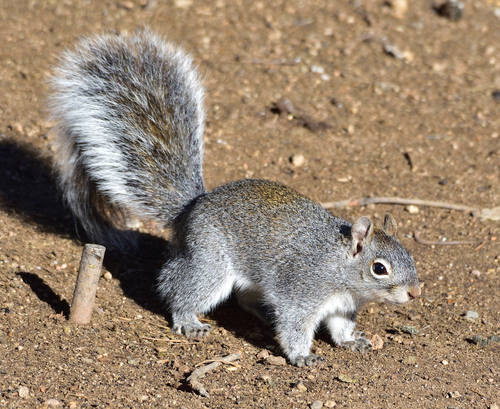
The Arizona Gray Squirrel is a medium-to-large squirrel characterized by its long, bushy tail and soft, salt-and-pepper gray fur on its back, often showing a subtle yellowish-brown wash along its spine. Its underparts are a clean, contrasting white to pale cream, and it features a distinctive white eye-ring. The underside of its magnificent tail is marked with dark charcoal or black bands bordered by a fringe of bright white hair, which it often flicks when agitated.
Kategorie
SäugetiereSeltenheit
Common
Gefahr
1/5 · Sehr gering
Snaps
Mach den ersten Snap!
They are highly dependent on the Arizona Walnut, and their local distribution closely mirrors the presence of these native trees.
Unlike many other squirrel species, they do not hibernate and remain active throughout the winter, relying on cached food reserves.
When threatened, they often freeze flat against a tree branch, using their salt-and-pepper coloration to blend perfectly with the bark.
Possesses highly flexible ankle joints that can rotate 180 degrees, allowing it to descend tree trunks headfirst with remarkable speed and stability.
Uses an acute sense of smell to bury walnuts and acorns across a wide area, memory-mapping locations to retrieve them during the winter.
Utilizes a series of raspy, chucking barks and tail flicks to communicate danger and warn family members of nearby predators.
Primarily feeds on acorns, pine seeds, and walnuts, supplementing its diet with fungi, flowers, berries, and occasionally insects or bird eggs.
Altersunterschiede: Juveniles rely on milk before transitioning to soft flowers, buds, and eventually hard-shelled nuts as their teeth mature.
Juglans major
Feeds heavily on the nuts of this tree, aiding in seed dispersal.
Accipiter cooperii
Preys upon the squirrel, especially juveniles, in canyon habitats.
Sciurus nayaritensis
Competes for acorns and nesting sites in oak woodlands.
Für dieses Objekt sind noch keine Merkmal-Badges vergeben.
Noch keine Alternativnamen vorhanden.
Sammlungen für dieses Objekt erscheinen hier, wenn weitere Themen hinzugefügt werden.
Gefahr
1/5 · Sehr gering
Noch keine besonderen Sicherheitshinweise.
Der einfachste Weg, Arizona Gray Squirrel zu bestimmen, ist die Verwendung der Naturführer-App Snappit.
Primarily feeds on acorns, pine seeds, and walnuts, supplementing its diet with fungi, flowers, berries, and occasionally insects or bird eggs.
Found in deep, wooded riparian canyons and mixed pine-oak forests of the southwestern deserts and highlands.
Foraging
Zoome hinein, um Cluster aufzulösen und zu sehen, wo dieses Objekt fotografiert wurde.
Neueste Snaps erscheinen hier, wenn neue Beobachtungen hinzukommen.