

Armenian Blackberry
rubus armeniacus
The Armenian Blackberry (Rubus armeniacus) is a robust, fast-growing deciduous shrub famous for its abundant crop of sweet, juicy dark berries. Native to Armenia and the Caucasus, it was introduced to many parts of the world, including North America, where it has become a highly successful and often invasive species. It is a dominant force in disturbed landscapes, forming dense, impenetrable thickets that redefine local ecosystems. Despite its aggressive nature, it remains a favorite forage plant for humans and wildlife alike during the late summer months. Its arching woody stems can grow several meters in a single season, quickly overtaking roadsides, riverbanks, and abandoned fields.
Lebensraum: Thrives in disturbed soils, roadsides, forest edges, riparian zones, and fields, often creating vast, dense brambles.
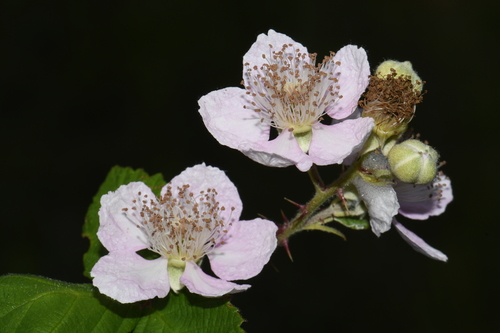
This plant is easily identified by its extremely thick, five-angled, reddish-green arching canes heavily armed with large, curved thorns. The leaves are palmately compound, usually featuring five large, oval leaflets that are dark green on top with a distinct, silvery-white underside felted with fine hairs. In late spring and summer, it produces clusters of white-to-light-pink five-petaled flowers, which give way to aggregate fruits that turn from green to bright red, and finally to a glossy, deep black when ripe.
Kategorie
PflanzenSeltenheit
Common
Gefahr
1/5 · Sehr gering
Snaps
Mach den ersten Snap!
A single plant can produce thousands of seeds per year, which remain viable in the soil seed bank for several years waiting for light to germinate.
Despite its common name 'Himalayan blackberry' in North America, the species actually originated in Armenia and the Caucasus region.
Its dense, thorny thickets are so impenetrable that they can create barriers for large mammals, but they provide excellent nesting sites for small birds protected from predators.
When the long, arching canes touch the soil, they can quickly sprout new roots, allowing the plant to rapidly clone itself and expand.
Lined with fierce, recurved thorns, the canes deter large herbivores and act as climbing anchors to scramble over competing plants.
By producing highly palatable, sweet fruits, the plant enlists birds and mammals to distribute its seeds over vast distances via their droppings.
As a photoautotrophic plant, it produces its own energy via photosynthesis, utilizing sunlight, water, and carbon dioxide while drawing minerals from the soil.
Apis mellifera
Bees pollinate the flowers while harvesting nectar and pollen.
Drosophila suzukii
This invasive pest lays eggs inside the ripening blackberries, and the larvae feed on the fruit.
Turdus migratorius
Robins eat the ripe berries and widely disperse the seeds in their droppings.
Für dieses Objekt sind noch keine Merkmal-Badges vergeben.
Noch keine Alternativnamen vorhanden.
Sammlungen für dieses Objekt erscheinen hier, wenn weitere Themen hinzugefügt werden.
Gefahr
1/5 · Sehr gering
Noch keine besonderen Sicherheitshinweise.
Der einfachste Weg, Armenian Blackberry zu bestimmen, ist die Verwendung der Naturführer-App Snappit.
200-1200 cm
5-25 Jahre
As a photoautotrophic plant, it produces its own energy via photosynthesis, utilizing sunlight, water, and carbon dioxide while drawing minerals from the soil.
Thrives in disturbed soils, roadsides, forest edges, riparian zones, and fields, often creating vast, dense brambles.
Zoome hinein, um Cluster aufzulösen und zu sehen, wo dieses Objekt fotografiert wurde.
Neueste Snaps erscheinen hier, wenn neue Beobachtungen hinzukommen.

California, US
Hier kann man sehen Ente, Amerikanisches Blässhuhn und Kanadagans.
Führer anzeigen →

Washington, US
Hier kann man sehen Rotfuchs, Fichtenspargel und Armenian Blackberry.
Führer anzeigen →