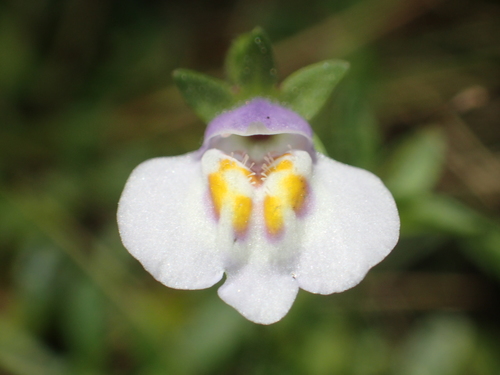


Asian Mazus
mazus pumilus
Asian Mazus (Mazus pumilus) is a diminutive, low-growing annual herb native to East and South Asia. Despite its small size, this resilient plant has successfully naturalized in many temperate and subtropical regions globally, often establishing itself in lawns, gardens, and disturbed soils. It is recognized by its charming, tiny purplish-blue or white flowers that resemble miniature orchids. This opportunistic species thrives in moist, sunny to partially shaded environments, spreading rapidly to form dense mats. It serves as an important early-season food source for small pollinating insects and is highly regarded for its ability to tolerate heavy foot traffic and frequent mowing, making it a common sight in urban turfgrasses.
Lebensraum: Found in moist, disturbed environments such as lawns, gardens, agricultural fields, and wet ditches.
This low-lying herb reaches heights of only 5 to 15 cm. Its leaves are obovate or spatulate, arranged oppositely along the stems, with coarsely toothed margins. The flowers, measuring roughly 1 cm in length, are two-lipped; the upper lip is short and purplish-blue, while the larger lower lip is three-lobed, pale purple or white, and features two prominent yellow-ridged swells covered in fine hairs that act as a nectar guide.
Kategorie
PflanzenSeltenheit
Common
Gefahr
1/5 · Sehr gering
Snaps
Mach den ersten Snap!
Because it tolerates heavy foot traffic, some gardeners use it as a 'step-able' alternative to traditional grass lawns in damp areas.
In its native East Asian range, it is sometimes used in traditional herbal remedies to treat simple ailments like fevers.
The genus name 'Mazus' comes from the Greek word 'mazos', which means 'breast', referring to the two prominent ridges on the flower's lower lip.
Adapts its growth form to hug the ground extremely closely, allowing it to survive, photosynthesize, and bloom even under frequent mowing.
Features raised, yellow-and-white hairy ridges on its lower petal that physically steer tiny insect pollinators toward its reproductive organs.
Completes its entire life cycle from germination to seed dispersal in a matter of weeks, enabling swift colonization of newly disturbed soil.
As a photoautotrophic plant, it synthesizes its own organic compounds using sunlight, carbon dioxide, water, and essential mineral nutrients absorbed from the soil.
Lasioglossum
Provides nectar and pollen to small wild bees in exchange for pollination.
Taraxacum officinale
Competes for space, light, and soil nutrients in urban lawns and fields.
Cornu aspersum
The tender leaves and stems are occasionally consumed by foraging terrestrial gastropods.
Für dieses Objekt sind noch keine Merkmal-Badges vergeben.
Noch keine Alternativnamen vorhanden.
Sammlungen für dieses Objekt erscheinen hier, wenn weitere Themen hinzugefügt werden.
Gefahr
1/5 · Sehr gering
Noch keine besonderen Sicherheitshinweise.
Der einfachste Weg, Asian Mazus zu bestimmen, ist die Verwendung der Naturführer-App Snappit.
5-15 cm
0.001-0.02 kg
0-1 Jahre
As a photoautotrophic plant, it synthesizes its own organic compounds using sunlight, carbon dioxide, water, and essential mineral nutrients absorbed from the soil.
Found in moist, disturbed environments such as lawns, gardens, agricultural fields, and wet ditches.
Zoome hinein, um Cluster aufzulösen und zu sehen, wo dieses Objekt fotografiert wurde.
Neueste Snaps erscheinen hier, wenn neue Beobachtungen hinzukommen.














.jpeg&width=800)