

Astiptodonta Aonides
astiptodonta aonides
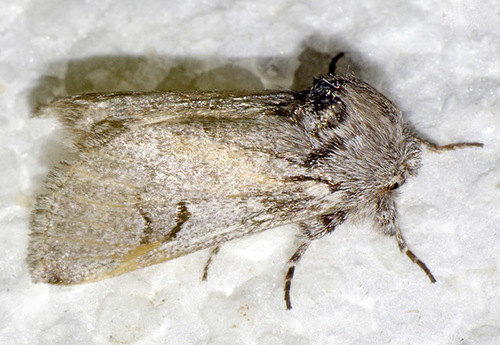
Astiptodonta aonides, commonly known as the Aonides prominent moth, is a captivating member of the family Notodontidae native to the deciduous forests of eastern North America. These insects are marvels of natural camouflage, blending flawlessly with the bark of their host trees during the day to avoid visual predators like birds. As caterpillars, they are diligent herbivores that feed on oaks, while the adults live brief lives dedicated purely to reproduction, relying entirely on stored energy.
Lebensraum: Found in deciduous forests and oak woodlands across eastern North America.
Adults typically have a wingspan of 3 to 5 centimeters, sporting intricately patterned forewings in shades of slate gray, charcoal, and wood brown that perfectly replicate tree bark. Their hindwings are a simpler, lighter grayish-brown. When resting, they fold their wings closely over their back in a steep, roof-like posture, hiding their legs and antennae to enhance their bark-like appearance.
Kategorie
InsektenSeltenheit
Common
Gefahr
1/5 · Sehr gering
Snaps
Mach den ersten Snap!
Adult Aonides prominent moths have vestigial mouthparts and do not eat a single meal during their adult lives.
The species name 'aonides' refers to Aonia, a classical region in Greece associated with the Muses, referencing the artistic pattern on its wings.
Their caterpillars deliberately cut and drop leaf fragments to hide signs of their feeding activity from foraging birds.
The moth's forewing pattern closely mimics tree bark texture and coloration, allowing it to remain virtually invisible to predators when resting on tree trunks.
When threatened by predators or parasitoid wasps, the caterpillar thrashes violently to deter attackers.
Males possess highly sensitive feathered antennae capable of detecting female pheromones from great distances in dark forest canopies.
The caterpillars feed strictly on the leaves of oak trees, while the adult moths do not feed at all due to vestigial mouthparts.
Altersunterschiede: Larvae are voracious leaf feeders, whereas adults have no functional mouthparts and do not consume food.
Quercus alba
The larvae feed on the foliage of this primary host tree.
Cyanocitta cristata
This bird actively searches tree trunks for resting moths and caterpillars.
Peromyscus leucopus
Forages in leaf litter and preys upon the subterranean pupae during the winter.
Für dieses Objekt sind noch keine Merkmal-Badges vergeben.
Noch keine Alternativnamen vorhanden.
Sammlungen für dieses Objekt erscheinen hier, wenn weitere Themen hinzugefügt werden.
Gefahr
1/5 · Sehr gering
Noch keine besonderen Sicherheitshinweise.
Der einfachste Weg, Astiptodonta Aonides zu bestimmen, ist die Verwendung der Naturführer-App Snappit.
2+ cm
3+ cm
0.0001+ kg
0+ Jahre
15 km/h
The caterpillars feed strictly on the leaves of oak trees, while the adult moths do not feed at all due to vestigial mouthparts.
Found in deciduous forests and oak woodlands across eastern North America.
Zoome hinein, um Cluster aufzulösen und zu sehen, wo dieses Objekt fotografiert wurde.
Neueste Snaps erscheinen hier, wenn neue Beobachtungen hinzukommen.














