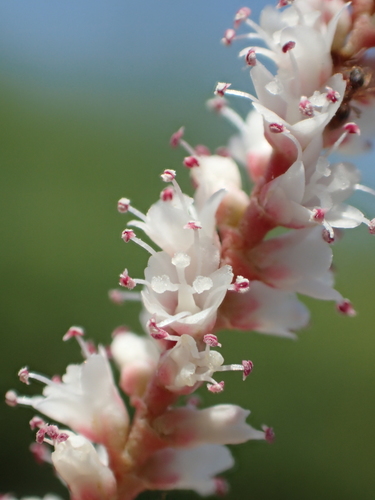


Athel Tamarisk
tamarix aphylla
Athel Tamarisk (Tamarix aphylla) is a remarkable, fast-growing evergreen tree adapted to some of the harshest, most saline environments on Earth. Native to arid regions of North Africa, the Middle East, and South Asia, it is highly valued as a windbreak and shade tree in desert landscapes. It has earned a reputation for being exceptionally drought-tolerant, thanks to a deep, specialized root system that can reach ground-water sources deep beneath desert sands. However, in regions where it has been introduced, such as Australia and the southwestern United States, its aggressive growth and ability to alter soil chemistry can make it a problematic invasive species.
Lebensraum: Typically found in arid and semi-arid desert washes, saline plains, coastal dunes, and along seasonal watercourses.
This medium-to-large tree can reach heights of 10 to 18 meters, featuring a dense, spreading crown of weeping, gray-green foliage. Up close, its leaves are reduced to minute, scale-like sheaths that clasp the jointed, needle-like twigs, giving the tree a virtually leafless appearance. The trunk is covered in rough, deeply fissured reddish-brown to grey bark. During summer, it produces small, delicate spikes of pale pink to white flowers clustered at the ends of its branches, which later give way to tiny, bell-shaped seed capsules.
Kategorie
PflanzenSeltenheit
Common
Gefahr
1/5 · Sehr gering
Snaps
Mach den ersten Snap!
By dripping salt onto the surrounding ground, it creates a toxic zone of salty soil that prevents native plants from growing nearby.
Its wood is surprisingly dense and heavy, making it a highly valued source of firewood and charcoal in hyper-arid regions.
The species name 'aphylla' means 'without leaves,' referring to its highly reduced, scale-like foliage.
Possesses specialized salt glands on its foliage that excrete excess salt, which drops to the ground and suppresses competing vegetation.
Develops an incredibly deep taproot system capable of reaching water tables dozens of meters below the surface.
Utilizes highly reduced, scale-like leaves to drastically minimize water loss through transpiration in scorching desert climates.
As a photoautotroph, the Athel Tamarisk uses chlorophyll in its green stems and scale-like leaves to produce energy from sunlight, carbon dioxide, and water.
Diorhabda elongata
Defoliates the tree, acting as a biological control agent in areas where the tamarisk is invasive.
Apis mellifera
Visits the pinkish-white flowers to collect nectar and assist in pollination.
Für dieses Objekt sind noch keine Merkmal-Badges vergeben.
Noch keine Alternativnamen vorhanden.
Sammlungen für dieses Objekt erscheinen hier, wenn weitere Themen hinzugefügt werden.
Gefahr
1/5 · Sehr gering
Noch keine besonderen Sicherheitshinweise.
Der einfachste Weg, Athel Tamarisk zu bestimmen, ist die Verwendung der Naturführer-App Snappit.
1000-1800 cm
50-150 Jahre
As a photoautotroph, the Athel Tamarisk uses chlorophyll in its green stems and scale-like leaves to produce energy from sunlight, carbon dioxide, and water.
Typically found in arid and semi-arid desert washes, saline plains, coastal dunes, and along seasonal watercourses.
Zoome hinein, um Cluster aufzulösen und zu sehen, wo dieses Objekt fotografiert wurde.
Neueste Snaps erscheinen hier, wenn neue Beobachtungen hinzukommen.

California, US
Hier kann man sehen Kreosotbusch, Desert Holly und Cottontop Cactus.
Führer anzeigen →

California, US
Hier kann man sehen Kolkrabe und Rotschwanzbussard.
Führer anzeigen →

US
Hier kann man sehen Mexikanischer Palo Verde, Ocotillo und Pfahlrohr.
Führer anzeigen →












_02.jpg&width=800)