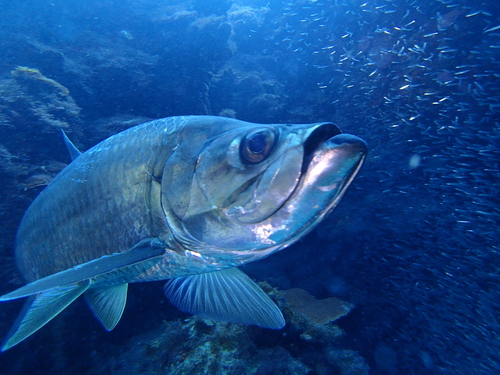


Atlantic Tarpon
megalops atlanticus
Known affectionately as the 'Silver King,' the Atlantic Tarpon is one of the most iconic and highly respected game fishes in the warm coastal waters of the Atlantic Ocean. Renowned for their incredible acrobatic leaps when hooked, these massive, prehistoric-looking fish command awe from anglers and nature enthusiasts alike. They possess a unique, highly specialized swim bladder attached to their esophagus, allowing them to gulp atmospheric air at the surface and survive in oxygen-poor habitats where other fish would quickly perish. This fascinating biological adaptation, coupled with their sheer size and shimmering silver scales, makes encountering a tarpon an unforgettable experience. Beyond their recreational value, Atlantic Tarpons are ancient survivors, with fossil records tracing their lineage back millions of years, perfectly evolved to dominate their coastal and estuarine environments.
Lebensraum: Typically found in warm, shallow coastal waters, estuaries, bays, and mangrove lagoons, and occasionally venturing far into freshwater rivers.
The Atlantic Tarpon is immediately recognizable by its massive, heavily armored, brilliant silver scales that can measure up to two inches across. It features a robust, streamlined body with a prominent, upward-pointing lower jaw indicative of a superior mouth used for striking prey from below. The back is typically a dark blue-to-greenish or gray-black color, transitioning to dazzling silver along the sides and belly. A major distinguishing characteristic is the elongated last ray of its dorsal fin, which trails far down its back towards the tail. Their large, dark, wide-set eyes and deeply forked tail fin complete the profile of this powerful and elegant swimmer.
Kategorie
FischeSeltenheit
Common
Gefahr
1/5 · Sehr gering
Snaps
Mach den ersten Snap!
Because they swallow their prey whole without chewing, tarpon have highly bony mouths that feel like sandpaper, making it notoriously difficult for anglers to set a hook.
Tarpon undergo a fascinating leptocephalus larval stage, where they look like transparent, ribbon-like eels before shrinking and transforming into their adult fish shape.
The oldest tarpon on record in captivity, a female affectionately named 'Babosa', lived to be 63 years old at the John G. Shedd Aquarium in Chicago.
Their massive silver scales, which can be larger than a silver dollar, were historically used by indigenous coastal peoples as tools, jewelry, and ornamental decorations.
They possess a modified swim bladder that acts like a primitive lung, allowing them to gulp air at the surface to survive in stagnant, oxygen-depleted waters.
When startled or hooked, tarpon are famous for launching their massive bodies high out of the water, performing dramatic mid-air twists and flips.
They are highly adaptable to extreme variations in salinity, capable of thriving in the open ocean, brackish coastal estuaries, and pure freshwater rivers.
Atlantic Tarpons are opportunistic predators that swallow their prey whole, primarily hunting schooling fish and large crustaceans.
Altersunterschiede: Larvae absorb nutrients directly from seawater and eat zooplankton; juveniles hunt small insects and fishes in marshes, while adults target larger schooling fish and crustaceans.
Carcharhinus leucas
Bull sharks are one of the few natural predators capable of taking down adult Atlantic Tarpons.
Mugil cephalus
Striped mullet form a large and essential part of the adult tarpon's diet in coastal estuaries.
Sphyrna mokarran
Great hammerheads are known to actively hunt and aggressively consume large adult tarpon in coastal waters.
Für dieses Objekt sind noch keine Merkmal-Badges vergeben.
Noch keine Alternativnamen vorhanden.
Sammlungen für dieses Objekt erscheinen hier, wenn weitere Themen hinzugefügt werden.
Gefahr
1/5 · Sehr gering
Noch keine besonderen Sicherheitshinweise.
Der einfachste Weg, Atlantic Tarpon zu bestimmen, ist die Verwendung der Naturführer-App Snappit.
120-250 cm
25-160 kg
30-55 Jahre
56 km/h
Atlantic Tarpons are opportunistic predators that swallow their prey whole, primarily hunting schooling fish and large crustaceans.
Typically found in warm, shallow coastal waters, estuaries, bays, and mangrove lagoons, and occasionally venturing far into freshwater rivers.
Ambush
Zoome hinein, um Cluster aufzulösen und zu sehen, wo dieses Objekt fotografiert wurde.
Neueste Snaps erscheinen hier, wenn neue Beobachtungen hinzukommen.


















