

Babirusas
babyrousa
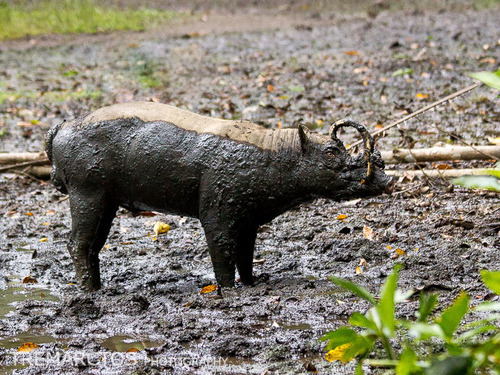
Babirusas, often called "pig-deer," are bizarre and captivating members of the pig family native to the tropical islands of Indonesia. They are famous for the extraordinary, curving tusks of the males, which pierce through the top of the snout and arch backwards toward the eyes. Unlike typical wild pigs, babirusas have long, slender legs, relatively hairless skin, and a multi-chambered stomach that allows them to process fiber like a ruminant. They are gentle, social animals that play a key ecological role in their native rainforests.
Lebensraum: Found in tropical rainforests, swampy riverine environments, and areas near mineral-rich salt licks on Indonesian islands.
The babirusa features a barrel-shaped body covered in tough, sparsely-haired, brownish-grey or slate-coloured skin. They lack the prominent facial warts found in other wild pigs, but the males possess dramatic, ivory-like canine teeth; the lower canines grow upwards, while the upper canines emerge vertically through the skin of the snout, curving backwards toward the forehead. They stand on long, delicate legs and can grow to about 85 to 110 centimeters in length and 60 to 100 kilograms in weight.
Kategorie
SäugetiereSeltenheit
Common
Gefahr
1/5 · Sehr gering
Snaps
Mach den ersten Snap!
If a male babirusa does not wear down or break its upper tusks through active rubbing, the tusks can occasionally grow long enough to curve around and pierce its own skull.
The name 'Babirusa' literally translates to 'pig-deer' in the Indonesian language, inspired by their long, slender legs and deer-like stance.
Unlike most other wild pigs, the babirusa lacks a rostral bone in its snout, meaning it does not use its nose to root aggressively in the soil, preferring to forage above ground.
Males use their unique, backward-curving upper tusks to deflect and parry the thrusts of rivals during combat, protecting their eyes from injury.
Babirusas are exceptionally strong swimmers, easily crossing wide rivers and traveling between close islands to find new foraging grounds.
They possess a complex, multi-chambered stomach that allows them to break down tough cellulose and leaf matter far more effectively than other pig species.
An omnivorous diet consisting primarily of fallen fruits, nuts, leaves, and fungi, supplemented by small invertebrates and mineral clay.
Ailurops ursinus
The Sulawesi Bear Cuscus shares canopy-level fruit resources with the babirusa and can compete for newly fallen tropical figs.
Malayopython reticulatus
The Reticulated Python is a formidable predator in the Sulawesian forest that opportunistically preys upon vulnerable babirusa piglets.
Macaca nigra
The Sulawesi Crested Macaque occasionally feeds alongside babirusas on fallen fruits and can compete for ground-level food resources.
Für dieses Objekt sind noch keine Merkmal-Badges vergeben.
Noch keine Alternativnamen vorhanden.
Sammlungen für dieses Objekt erscheinen hier, wenn weitere Themen hinzugefügt werden.
Gefahr
1/5 · Sehr gering
Noch keine besonderen Sicherheitshinweise.
Der einfachste Weg, Babirusas zu bestimmen, ist die Verwendung der Naturführer-App Snappit.
An omnivorous diet consisting primarily of fallen fruits, nuts, leaves, and fungi, supplemented by small invertebrates and mineral clay.
Found in tropical rainforests, swampy riverine environments, and areas near mineral-rich salt licks on Indonesian islands.
Foraging
Zoome hinein, um Cluster aufzulösen und zu sehen, wo dieses Objekt fotografiert wurde.
Neueste Snaps erscheinen hier, wenn neue Beobachtungen hinzukommen.