

Bailey'S Ballmoss
tillandsia baileyi
Bailey's Ballmoss (Tillandsia baileyi) is an enchanting epiphytic air plant native to the semi-arid woodlands of southern Texas and northeastern Mexico. Unlike typical terrestrial plants, it lives high in the forest canopy, anchoring itself securely to the bark of host trees rather than rooting in soil. It is a slow-growing perennial that forms striking, whimsical clusters of curling, wire-like leaves. Its unique adaptation to survive solely on moisture and nutrients from the air makes it an incredibly resilient and fascinating subject for plant enthusiasts and nature spotters alike.
Lebensraum: Typically found perched on the branches of Southern Live Oaks and Texas Ebony trees in subtropical, semi-arid woodlands.
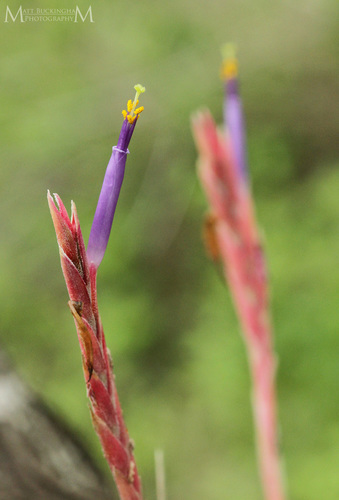
This bromeliad features a distinctive bulbous base from which narrow, stiff, grey-green leaves emerge, twisting and curling dramatically as they grow. The leaves are covered in fine, silvery hair-like structures called trichomes, giving the entire plant a dusty or frosted appearance. When preparing to bloom, it produces a slender, upright flower spike that flushes with pink to red tones, ultimately bearing tubular, violet-purple flowers that stand out against the grey-green foliage.
Kategorie
PflanzenSeltenheit
Common
Gefahr
1/5 · Sehr gering
Snaps
Mach den ersten Snap!
Despite being called 'ballmoss', it is not a moss at all, but a true flowering plant closely related to pineapples.
It is monocarpic, meaning each individual rosette will flower only once in its lifetime before focusing its remaining energy on producing clones or 'pups'.
Its seeds have fine, silky parachutes that allow them to float on the wind until they catch onto a suitable tree branch.
Uses specialized microscopic leaf scales called trichomes to efficiently absorb water, dust, and dissolved nutrients directly from the surrounding atmosphere.
Possesses tough, wiry roots designed exclusively to anchor the plant securely to tree bark, resisting high winds without parasitizing the host.
Utilizes Crassulacean Acid Metabolism, keeping its stomata closed during the hot day to conserve water and opening them at night to collect carbon dioxide.
As an autotrophic epiphyte, it synthesizes its own energy using sunlight, while absorbing essential minerals and moisture from rain, air, and organic debris through its leaves.
Quercus virginiana
Uses the branches of this tree as a physical anchor to access sunlight in the canopy without taking nutrients from it.
Archilochus colubris
Pollinates the bright purple flowers of the ballmoss while feeding on its nectar.
Ebenopsis ebano
Provides an alternative nesting substrate and host branch system in the Rio Grande Valley.
Für dieses Objekt sind noch keine Merkmal-Badges vergeben.
Noch keine Alternativnamen vorhanden.
Sammlungen für dieses Objekt erscheinen hier, wenn weitere Themen hinzugefügt werden.
Gefahr
1/5 · Sehr gering
Noch keine besonderen Sicherheitshinweise.
Der einfachste Weg, Bailey'S Ballmoss zu bestimmen, ist die Verwendung der Naturführer-App Snappit.
10-40 cm
0.02-0.15 kg
5-15 Jahre
As an autotrophic epiphyte, it synthesizes its own energy using sunlight, while absorbing essential minerals and moisture from rain, air, and organic debris through its leaves.
Typically found perched on the branches of Southern Live Oaks and Texas Ebony trees in subtropical, semi-arid woodlands.
Filtering
Zoome hinein, um Cluster aufzulösen und zu sehen, wo dieses Objekt fotografiert wurde.
Neueste Snaps erscheinen hier, wenn neue Beobachtungen hinzukommen.

















