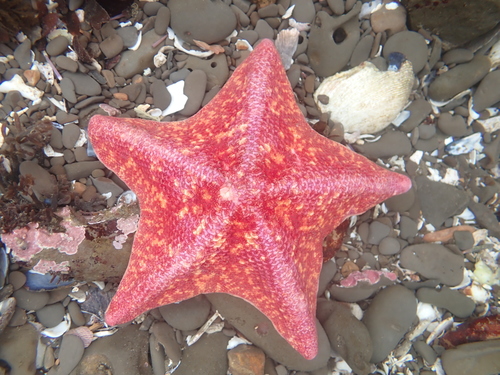


Bat Star
patiria miniata
The bat star (Patiria miniata) is a highly recognizable marine invertebrate native to the rocky coastlines of the Pacific Northwest. Well known for the distinctive webbing between its arms, which gives it a bat-like appearance, this starfish plays a vital role in tide pool and kelp forest ecosystems. Unlike many other sea stars that are strict predators, the bat star is an opportunistic omnivore and scavenger, consuming algae, decaying organic matter, and small encrusting organisms. They serve as nature's benthic cleanup crew, keeping the rocky seafloor clear of detritus. These fascinating creatures come in a brilliant kaleidoscope of colors, ranging from deep purple and fiery orange to mottled green and yellow, making them a favorite find for tidepoolers and divers alike.
Lebensraum: Typically found on rocky reefs, sandy bottoms, and kelp holdfasts in low intertidal and subtidal zones down to depths of about 290 meters.
The bat star is easily identified by its broad, chunky body with typically five (but sometimes up to nine) short, triangular arms connected by prominent webbing. It lacks the long, distinct arms of other sea stars, giving it a somewhat pentagonal shape. Their upper surface is covered in small, crescent-shaped ossicles, giving them a smooth, suede-like texture rather than a spiny one. They exhibit an incredibly diverse range of solid or mottled colors, including red, orange, yellow, brown, green, and purple, and typically grow to a diameter of 10 to 20 centimeters.
Kategorie
AnimalSeltenheit
Common
Gefahr
1/5 · Sehr gering
Snaps
Mach den ersten Snap!
Their distinctive webbed arms resemble a bat's wings, which is how they earned their common name.
They possess an incredible ability to regenerate lost arms, although they do so at a much slower rate than some other starfish species.
When two bat stars meet, they may engage in a gentle, slow-motion 'wrestling match' by pushing their arms against one another to establish feeding territory.
The bat star can evert its stomach through its mouth, allowing it to digest large, solid, or encrusted food sources externally on the rocky substrate.
It regularly hosts specialized polychaete worms in its ambulacral grooves, which help defend the host star from predators and feed on leftover food scraps.
At the tip of each arm, the bat star possesses light-sensitive eyespots and specialized sensory tube feet that detect chemical signals to guide it toward food.
Bat stars are opportunistic omnivores and scavengers, grazing on algae, bryozoans, and decaying organic matter on the seafloor.
Altersunterschiede: Microscopic larvae feed on plankton in the water column, while settled juveniles and adults transition to a benthic omnivorous diet.
Pycnopodia helianthoides
The sunflower sea star is a major predator that hunts and consumes bat stars.
Arctonoe vittata
A symbiotic worm that frequently lives in the grooves on the underside of the bat star.
Enhydra lutris nereis
Sea otters occasionally prey upon bat stars when other, more preferred food sources are scarce.
Für dieses Objekt sind noch keine Merkmal-Badges vergeben.
Noch keine Alternativnamen vorhanden.
Sammlungen für dieses Objekt erscheinen hier, wenn weitere Themen hinzugefügt werden.
Gefahr
1/5 · Sehr gering
Noch keine besonderen Sicherheitshinweise.
Der einfachste Weg, Bat Star zu bestimmen, ist die Verwendung der Naturführer-App Snappit.
10-20 cm
0.1-0.3 kg
10-35 Jahre
Bat stars are opportunistic omnivores and scavengers, grazing on algae, bryozoans, and decaying organic matter on the seafloor.
Typically found on rocky reefs, sandy bottoms, and kelp holdfasts in low intertidal and subtidal zones down to depths of about 290 meters.
Grazing
Zoome hinein, um Cluster aufzulösen und zu sehen, wo dieses Objekt fotografiert wurde.
Neueste Snaps erscheinen hier, wenn neue Beobachtungen hinzukommen.



