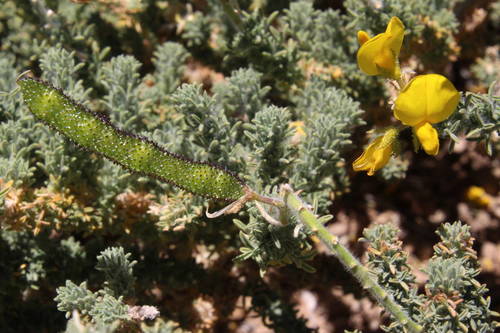


Bean-Trefoil
adenocarpus viscosus
Adenocarpus viscosus, commonly known as the Bean-Trefoil or Sticky Adenocarpus, is a remarkable high-altitude shrub endemic to the Canary Islands. Dominating the subalpine volcanic landscapes of Tenerife and La Palma, this hardy member of the pea family paints the rocky slopes with bursts of bright yellow flowers during its blooming season. Its ability to thrive in harsh, nutrient-poor volcanic soils makes it a cornerstone of its unique ecosystem. It is especially famous for the sticky, glandular hairs that coat its flower calyces and seed pods, a feature that earns it its specific epithet 'viscosus.' As a nitrogen-fixing plant, it plays a vital role in enriching the arid soils of places like Teide National Park, supporting a web of endemic insects and wildlife in an otherwise unforgiving environment.
Lebensraum: Found in dry, rocky, high-altitude subalpine zones and volcanic slopes, typically between 1,500 and 2,500 meters above sea level.
This densely branched, evergreen shrub typically grows between 0.5 and 2 meters tall. It features small, tightly clustered, dark green trifoliate leaves that are slightly hairy. During late spring and early summer, it erupts into dense terminal racemes of vibrant, golden-yellow, pea-like flowers. A key identifying trait is the presence of sticky, reddish-brown glandular hairs that prominently cover the flower bases (calyces) and the developing legume pods, giving the plant a distinctive tacky feel and a dotted appearance upon close inspection.
Kategorie
PflanzenSeltenheit
Common
Gefahr
1/5 · Sehr gering
Snaps
Mach den ersten Snap!
Despite being buried under snow in the winter and enduring blazing sun in the summer, this hardy shrub thrives in some of the highest elevations of the Canary Islands.
It is a foundational pioneer species in the extreme environment of Mount Teide, helping to build soil so other endemic plants can take root.
The species name 'viscosus' refers to the sticky, glue-like substance produced by glands on its seed pods, which easily stick to hikers' clothing.
Traditional beekeepers transport their hives up the mountainsides when the Bean-Trefoil blooms to produce a highly prized, single-flower mountain honey known as 'Miel de Retama del Teide'.
Symbiotically partners with soil bacteria in its root nodules to convert atmospheric nitrogen into usable nutrients, allowing it to thrive in poor volcanic soils.
Produces a sticky, viscous secretion on its reproductive parts that deters crawling insect herbivores and protects developing seeds.
Highly adapted to survive the intense solar radiation, strong winds, and extreme temperature fluctuations of subalpine volcanic calderas.
As a photosynthetic plant, it generates its own energy from sunlight while supplementing its nutritional needs through symbiotic nitrogen fixation.
Apis mellifera
Pollinates the flowers while gathering nectar to produce high-altitude honey.
Thymelicus christi
Relies on this plant as a critical nectar source in the high-altitude ecosystem.
Rhizobium leguminosarum
Inhabits root nodules to fix atmospheric nitrogen for the plant in exchange for carbohydrates.
Für dieses Objekt sind noch keine Merkmal-Badges vergeben.
Noch keine Alternativnamen vorhanden.
Sammlungen für dieses Objekt erscheinen hier, wenn weitere Themen hinzugefügt werden.
Gefahr
1/5 · Sehr gering
Noch keine besonderen Sicherheitshinweise.
Der einfachste Weg, Bean-Trefoil zu bestimmen, ist die Verwendung der Naturführer-App Snappit.
50-200 cm
10-50 Jahre
As a photosynthetic plant, it generates its own energy from sunlight while supplementing its nutritional needs through symbiotic nitrogen fixation.
Found in dry, rocky, high-altitude subalpine zones and volcanic slopes, typically between 1,500 and 2,500 meters above sea level.
Zoome hinein, um Cluster aufzulösen und zu sehen, wo dieses Objekt fotografiert wurde.
Neueste Snaps erscheinen hier, wenn neue Beobachtungen hinzukommen.









_Barbarea_vulgaris_-_Habit.jpg&width=800)