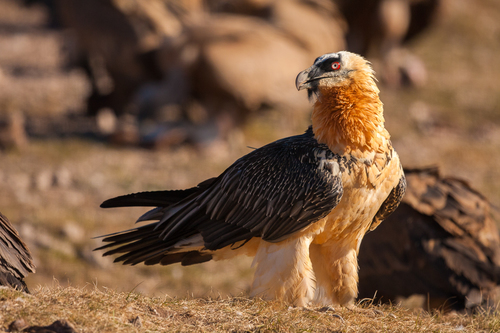


Bearded Vulture
gypaetus barbatus
The Bearded Vulture, also known as the Lammergeier, is a majestic raptor renowned for its highly specialized diet, primarily consisting of bone marrow. Unlike most vultures that feed on flesh, this species has evolved a unique strategy to consume bones, earning it the nickname "bone breaker." These magnificent birds play a crucial ecological role as nature's clean-up crew in high-altitude environments, efficiently disposing of carrion and preventing the spread of disease. Their striking appearance, coupled with their incredible ability to thrive in harsh mountain landscapes, makes them a truly captivating and important member of avian fauna.
Lebensraum: Found in rugged, high-altitude mountain ranges, typically near cliffs, gorges, and remote alpine pastures, where they can find suitable rocky terrain for dropping bones and nesting.
The Bearded Vulture is a large, imposing raptor with a distinctive appearance. Adults feature a rusty orange or yellowish-white head and underparts, often stained with iron oxides from mud-bathing. A black "beard" of bristles extends from under its beak, giving it its common name. The back and wings are dark grey to black, contrasting sharply with its lighter underside. It possesses powerful talons and a strong, hooked beak. In flight, its long, broad wings and long, wedge-shaped (diamond-shaped) tail are highly characteristic, distinguishing it from other vultures.
Kategorie
VögelSeltenheit
Common
Gefahr
1/5 · Sehr gering
Snaps
Mach den ersten Snap!
Bearded Vultures are the only known birds to have a diet that consists almost entirely of bone marrow, which they access by dropping bones from heights of 50-150 meters.
Historically, they were wrongly accused of carrying off lambs and even children, leading to widespread persecution and their extermination in many European regions by the early 20th century.
Their stomach acid is incredibly strong, allowing them to digest bone fragments that other animals cannot, making them the ultimate 'clean-up crew' of the mountains.
These vultures can live for over 40 years in captivity, a testament to their longevity and resilience.
The Bearded Vulture is a specialized osteophage, feeding almost exclusively on bones. It carries large bones high into the air and drops them onto rocks below, shattering them into smaller, digestible pieces to access the marrow.
Adult birds intentionally rub mud rich in iron oxides onto their chest and head feathers, staining them a reddish-orange hue. This behaviour is thought to be a display of dominance or a form of camouflage.
Equipped with long, broad wings and a lightweight skeleton, the Bearded Vulture is an exceptional glider, capable of soaring effortlessly on thermals at extreme altitudes in mountainous environments with minimal energy expenditure.
The Bearded Vulture has a highly specialized diet, consuming mainly bones and bone marrow from carcasses, rather than the flesh. They also eat small fragments of meat, ligaments, and skin.
Capra ibex
Main source of bones for consumption
Rupicapra rupicapra
Main source of bones for consumption
Gyps fulvus
Competitor for larger carcasses and carrion
Corvus corax
Competitor for small carrion, may also scavenge on bone fragments
Für dieses Objekt sind noch keine Merkmal-Badges vergeben.
Noch keine Alternativnamen vorhanden.
Sammlungen für dieses Objekt erscheinen hier, wenn weitere Themen hinzugefügt werden.
Gefahr
1/5 · Sehr gering
Noch keine besonderen Sicherheitshinweise.
Der einfachste Weg, Bearded Vulture zu bestimmen, ist die Verwendung der Naturführer-App Snappit.
95-125 cm
250-300 cm
4.5-7.8 kg
20-45 Jahre
100 km/h
The Bearded Vulture has a highly specialized diet, consuming mainly bones and bone marrow from carcasses, rather than the flesh. They also eat small fragments of meat, ligaments, and skin.
Found in rugged, high-altitude mountain ranges, typically near cliffs, gorges, and remote alpine pastures, where they can find suitable rocky terrain for dropping bones and nesting.
Zoome hinein, um Cluster aufzulösen und zu sehen, wo dieses Objekt fotografiert wurde.
Neueste Snaps erscheinen hier, wenn neue Beobachtungen hinzukommen.









.jpg&width=800)






