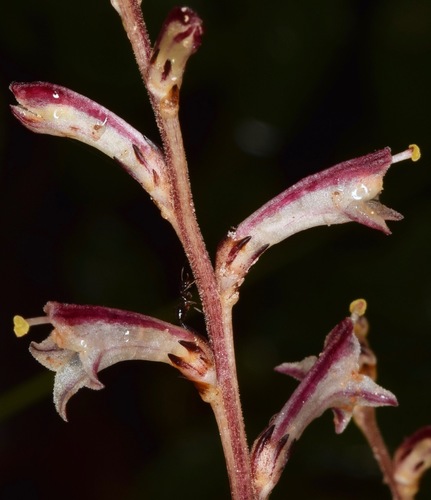


Beechdrops
epifagus virginiana
Beechdrops is a fascinating, non-photosynthetic parasitic plant native to the deciduous forests of eastern North America. Unlike most members of the plant kingdom, it lacks chlorophyll, meaning it cannot produce its own energy through photosynthesis. Instead, it survives by tapping into the root systems of American beech trees, drawing water, minerals, and organic nutrients directly from its host. Because of this extreme specialization, it is only found where beech trees thrive, making it an excellent indicator of a mature, healthy forest ecosystem. This unique evolutionary path has allowed Beechdrops to forgo leaves and green tissue entirely, resulting in a highly specialized, minimalist lifestyle.
Lebensraum: Found exclusively on the forest floor of mature deciduous forests, growing directly from the root systems of American beech trees.
This plant is easily identified by its slender, highly branched stems that range in color from tan to light brown or deep purple, often featuring pale vertical stripes. Lacking true leaves, it instead bears small, scale-like structures along its stems. It typically grows to a height of 10 to 45 centimeters. During its blooming period, it displays two distinct types of small, tubular flowers: the upper flowers are yellowish-white striped with purple and remain open, while the lower flowers are smaller, bud-like, and never open.
Kategorie
PflanzenSeltenheit
Common
Gefahr
1/5 · Sehr gering
Snaps
Mach den ersten Snap!
Beechdrops is completely incapable of photosynthesis, containing absolutely no green chlorophyll.
Its scientific genus name, Epifagus, literally translates from Greek as 'upon the beech', referencing its exclusive host.
The plant produces two types of flowers: sterile-looking lower flowers that fertilize themselves without opening, and upper showy flowers that can cross-pollinate.
Utilizes specialized root structures called haustoria to breach and feed off the vascular system of beech trees.
Produces both open, insect-pollinated flowers and self-pollinating closed flowers to ensure reproductive success in deep shade.
Saves vital metabolic energy by completely discarding the physiological machinery required for photosynthesis.
An obligate parasite that derives all carbon, water, and nutrients directly from the root system of its host tree.
Fagus grandifolia
The sole host species that Beechdrops parasitizes to obtain water and nutrients.
Prenolepis imparis
Visits the chasmogamous flowers of the plant, occasionally assisting in pollination.
Für dieses Objekt sind noch keine Merkmal-Badges vergeben.
Noch keine Alternativnamen vorhanden.
Sammlungen für dieses Objekt erscheinen hier, wenn weitere Themen hinzugefügt werden.
Gefahr
1/5 · Sehr gering
Noch keine besonderen Sicherheitshinweise.
Der einfachste Weg, Beechdrops zu bestimmen, ist die Verwendung der Naturführer-App Snappit.
An obligate parasite that derives all carbon, water, and nutrients directly from the root system of its host tree.
Found exclusively on the forest floor of mature deciduous forests, growing directly from the root systems of American beech trees.
Zoome hinein, um Cluster aufzulösen und zu sehen, wo dieses Objekt fotografiert wurde.
Neueste Snaps erscheinen hier, wenn neue Beobachtungen hinzukommen.









_Euphorbia_characias_-_inflorescences_-_Jardin_Botanique_Henri_GAUSSEN.jpg&width=800)










