

Big Bursage
ambrosia ambrosioides
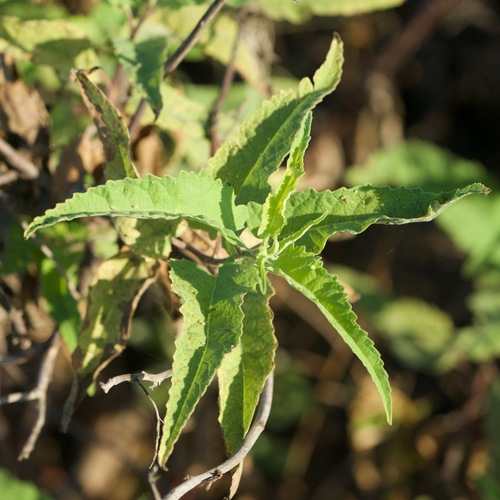
Big Bursage, or Ambrosia ambrosioides, is a robust, coarse perennial shrub native to the arid desert regions of the southwestern United States and northwestern Mexico. Characterized by its sprawling habit and deeply veined, resinous leaves, this plant is a staple of desert wash ecosystems. It plays a critical role in stabilizing loose, sandy soils along arroyos and canyons where seasonal flash floods occur. Unlike many delicate desert plants, Big Bursage is tough and resilient, maintaining a green presence in harsh, sun-baked environments. Its ecological value is immense; it acts as a nurse plant for young cacti and provides valuable shelter and cooler microclimates for diverse desert wildlife. Its aromatic, medicinal scent is a signature fragrance of the Sonoran Desert, especially after rare rainfall events.
Lebensraum: Found in sandy desert washes, rocky canyons, and gravelly arroyos of the Sonoran Desert.
Big Bursage grows as a sprawling, multi-stemmed subshrub standing between 100 and 200 centimeters tall. Its most distinctive features are its large, dull green, triangular to lance-shaped leaves that can reach up to 15 centimeters in length. The leaves have prominent, pale veins and coarsely serrated margins, giving them a rough, sandpaper-like texture and appearance. During its flowering season from late winter to spring, it produces clusters of small, green to yellowish flower heads at the branch tips that eventually mature into hard, dry, bur-like fruits covered in hooked spines.
Kategorie
PflanzenSeltenheit
Common
Gefahr
1/5 · Sehr gering
Snaps
Mach den ersten Snap!
Despite being called 'ragweed' or 'bursage', its genus name 'Ambrosia' is Greek for 'food of the gods', a stark contrast to its bitter taste and pungent smell.
Its burs behave like natural Velcro, hitching rides on animals to colonize new sandy bends miles down the wash.
Native Seri peoples traditionally valued the plant for its medicinal properties, using root decoctions to treat various internal ailments.
To conserve precious moisture during extreme summer heatwaves, the plant can shed its larger leaves and enter a semi-dormant state.
The seeds are encased in burs with hooked spines that easily cling to animal fur or human clothing, allowing the plant to spread across desert channels.
Its foliage is rich in aromatic terpenes and bitter oils that deter hungry herbivores and minimize water loss through evaporation.
Synthesizes energy from sunlight via photosynthesis, drawing water and essential mineral nutrients from deep desert soils.
Chaetodipus penicillatus
Feeds on the fallen seeds on the wash floor.
Ovis canadensis nelsoni
Occasionally browses on the coarse green leaves during dry seasons when other forage is scarce.
Dryophytes arenicolor
Finds shade and critical microclimate moisture beneath the wide branches in rocky canyons.
Für dieses Objekt sind noch keine Merkmal-Badges vergeben.
Noch keine Alternativnamen vorhanden.
Sammlungen für dieses Objekt erscheinen hier, wenn weitere Themen hinzugefügt werden.
Gefahr
1/5 · Sehr gering
Noch keine besonderen Sicherheitshinweise.
Der einfachste Weg, Big Bursage zu bestimmen, ist die Verwendung der Naturführer-App Snappit.
100-200 cm
5-20 Jahre
Synthesizes energy from sunlight via photosynthesis, drawing water and essential mineral nutrients from deep desert soils.
Found in sandy desert washes, rocky canyons, and gravelly arroyos of the Sonoran Desert.
Zoome hinein, um Cluster aufzulösen und zu sehen, wo dieses Objekt fotografiert wurde.
Neueste Snaps erscheinen hier, wenn neue Beobachtungen hinzukommen.

Arizona, US
Hier kann man sehen Saguaro-Kaktus und Fasskaktus Mit Angelhakenstacheln.
Führer anzeigen →

Arizona, US
Hier kann man sehen Chuparosa, Wüstendrossling und American Threefold.
Führer anzeigen →

Arizona, US
Hier kann man sehen Saguaro-Kaktus und Grahams Warzenkaktus.
Führer anzeigen →












