

Big Deervetch
hosackia crassifolia
Big Deervetch (Hosackia crassifolia) is a robust, erect herbaceous perennial native to western North America, thriving in moist forest clearings, chaparral, and disturbed montane slopes. As a member of the legume family, this plant plays a critical role in its ecosystem by forming symbiotic relationships with soil bacteria to fix nitrogen, enriching the soil for surrounding plant species. Its lush, leafy green appearance and unique flowering structures make it a standout species along trails and forest boundaries. Historically classified under the genus Lotus, Big Deervetch is highly valued by local wildlife. It serves as an essential food source for native herbivores and acts as an important host plant for various butterfly larvae. Its resilience in post-wildfire environments helps stabilize soil and initiate the regeneration of devastated forest floors, marking it as a pioneer species of ecological recovery.
Lebensraum: Found in moist forest openings, chaparral, and disturbed montane slopes of western North America.
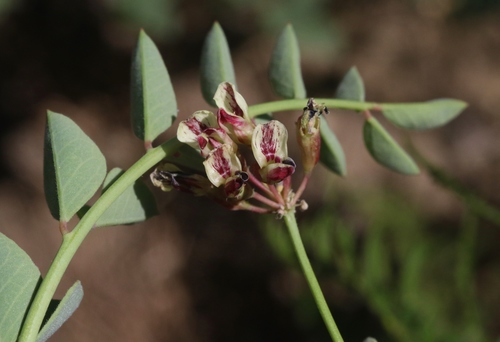
This species grows as an erect or sprawling herb, typically reaching heights of 50 to 150 centimeters, characterized by stout, hollow, and often reddish stems. Its pinnately compound leaves consist of 9 to 15 thick, somewhat fleshy, oval-shaped leaflets. The flowers are arranged in umbrella-like umbels, featuring the classic pea-like structure. These flowers are uniquely colored, blending greenish-yellow or cream with prominent reddish-purple spots or splotches, which eventually give way to slender, dark brown seed pods measuring 3 to 6 centimeters in length.
Kategorie
PflanzenSeltenheit
Common
Gefahr
1/5 · Sehr gering
Snaps
Mach den ersten Snap!
Big Deervetch plays a vital role in ecological succession, quickly colonizing recently burned forest areas and helping to restore nitrogen levels to the soil.
Despite its common name 'deervetch', it is actually a member of the legume family (Fabaceae) and is closely related to clovers and peas.
Its species name 'crassifolia' translates to 'thick-leaved', referencing the somewhat succulent, fleshy texture of its leaflets.
Formulates mutualistic relationships with Rhizobium bacteria in its roots to convert atmospheric nitrogen into a usable form for itself and nearby plants.
Quickly resprouts from its deep root system or germinates from heat-stimulated seeds following wildfire disturbances.
Utilizes a deep, woody taproot to access deeper water tables during hot, dry summer months in its native Mediterranean-climate range.
As a photosynthetic plant, Big Deervetch produces its own food using sunlight, water, and carbon dioxide, while obtaining nitrogen through symbiotic root bacteria.
Plebejus acmon
Provides critical foliage and structural support as a larval host plant.
Bombus vosnesenskii
Relies on these native insects for pollination of its specialized pea-like flowers.
Odocoileus hemionus
Grazes on the protein-rich leaves and stems of the plant.
Für dieses Objekt sind noch keine Merkmal-Badges vergeben.
Noch keine Alternativnamen vorhanden.
Sammlungen für dieses Objekt erscheinen hier, wenn weitere Themen hinzugefügt werden.
Gefahr
1/5 · Sehr gering
Noch keine besonderen Sicherheitshinweise.
Der einfachste Weg, Big Deervetch zu bestimmen, ist die Verwendung der Naturführer-App Snappit.
50-150 cm
3-10 Jahre
As a photosynthetic plant, Big Deervetch produces its own food using sunlight, water, and carbon dioxide, while obtaining nitrogen through symbiotic root bacteria.
Found in moist forest openings, chaparral, and disturbed montane slopes of western North America.
Absorption
Zoome hinein, um Cluster aufzulösen und zu sehen, wo dieses Objekt fotografiert wurde.
Neueste Snaps erscheinen hier, wenn neue Beobachtungen hinzukommen.




.jpg&width=800)







