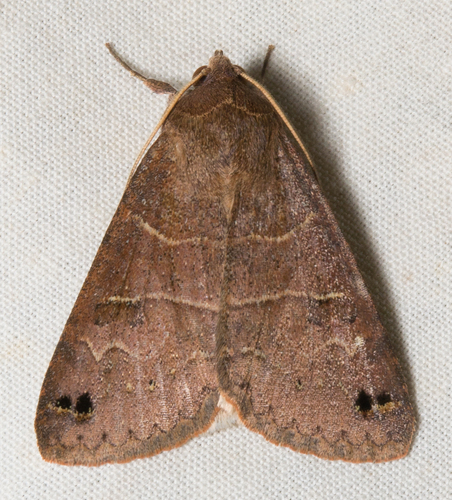


Black-Dotted Brown
cissusa spadix
The Black-Dotted Brown (Cissusa spadix) is a modest yet captivating moth belonging to the family Erebidae. Arriving as a herald of spring, it is among the earlier flying moths in its native North American range, taking wing when many other insects are still dormant. Its subtle beauty lies in its intricate wing patterns, which perfectly mimic the dead leaves and bark of its woodland habitat. This remarkable camouflage allows it to evade predators while resting during the day. As a night flyer, the Black-Dotted Brown is often drawn to porch lights and sugar baits, making it a familiar sight for keen-eyed naturalists and backyard moth enthusiasts exploring early-season woodlands.
Lebensraum: Typically found in deciduous and mixed woodlands, oak-hickory forests, and scrublands across North America where its host trees are abundant.
This moth features a relatively modest wingspan of 30 to 40 millimeters. Its forewings are typically colored in warm shades of reddish-brown, tan, or grayish-brown, traversed by fine, slightly wavy darker lines. The most distinguishing characteristic is the presence of several small, prominent black dots near the center and outer margins of the forewings, serving as subtle visual anchors in its otherwise cryptic patterning. The hindwings are generally a uniform, slightly paler brownish-gray. When at rest, the moth folds its wings flat against its body, resembling a dried oak leaf or a piece of textured tree bark.
Kategorie
InsektenSeltenheit
Common
Gefahr
1/5 · Sehr gering
Snaps
Mach den ersten Snap!
The Black-Dotted Brown is one of the first moths to appear in early spring, often flying on nights when there's still a noticeable chill in the air.
Unlike many moths that flock exclusively to flowers, adult Black-Dotted Browns are notoriously fond of 'sugaring'—they love feeding on fermenting tree sap and decaying fruit.
When resting on a tree trunk, this moth aligns its wings with the grooves of the bark to maximize its leaf-litter and bark-like camouflage.
The wing patterns and coloration perfectly mimic dead leaves and bark, rendering the moth almost invisible to daytime predators when resting on trees.
Capable of flying in the cooler temperatures of early spring, allowing it to emerge and mate before many potential predators and competing moth species become active.
Equipped with highly sensitive antennae that detect specific pheromones and the scents of tree sap or nectar from great distances in the dark.
Caterpillars primarily feed on the foliage of oak trees, while adult moths rely on tree sap, fermenting fruit, and occasionally nectar.
Altersunterschiede: Larvae are exclusively leaf-eating caterpillars (folivores), whereas adults possess a proboscis adapted for drinking liquid nourishment.
Quercus alba
Larvae feed extensively on the foliage of various oak species.
Eptesicus fuscus
Often falls prey to nocturnal insectivores like bats.
Baeolophus bicolor
Preyed upon by woodland birds during the day if their camouflage fails.
Für dieses Objekt sind noch keine Merkmal-Badges vergeben.
Noch keine Alternativnamen vorhanden.
Sammlungen für dieses Objekt erscheinen hier, wenn weitere Themen hinzugefügt werden.
Gefahr
1/5 · Sehr gering
Noch keine besonderen Sicherheitshinweise.
Der einfachste Weg, Black-Dotted Brown zu bestimmen, ist die Verwendung der Naturführer-App Snappit.
1-2 cm
3-4 cm
0.0001-0.0003 kg
0-1 Jahre
15 km/h
Caterpillars primarily feed on the foliage of oak trees, while adult moths rely on tree sap, fermenting fruit, and occasionally nectar.
Typically found in deciduous and mixed woodlands, oak-hickory forests, and scrublands across North America where its host trees are abundant.
Zoome hinein, um Cluster aufzulösen und zu sehen, wo dieses Objekt fotografiert wurde.
Neueste Snaps erscheinen hier, wenn neue Beobachtungen hinzukommen.









.jpg&width=800)
