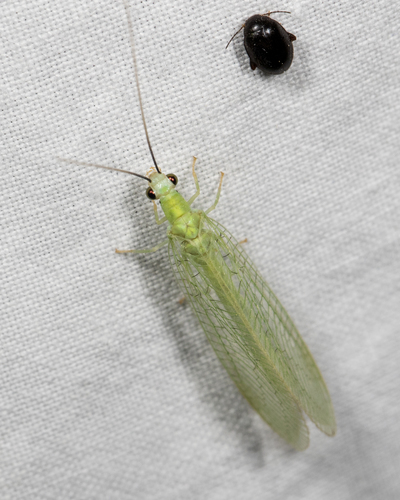


Black-Horned Green Lacewing
chrysopa nigricornis
The Black-Horned Green Lacewing, Chrysopa nigricornis, is a delicate yet formidable insect revered for its ecological role as a natural pest controller, especially in its larval stage. Often referred to as "aphid lions," the larvae are voracious predators of soft-bodied insects, making them invaluable allies in gardens and agricultural settings. This species undergoes complete metamorphosis, transforming from a crawling, hunting larva into a graceful, winged adult. Adults are typically nocturnal, attracted to lights, and play a role as pollinators, feeding on nectar and pollen. Their presence is a strong indicator of a healthy ecosystem.
Lebensraum: Found in diverse environments including gardens, agricultural fields, orchards, woodlands, and meadows, often associated with areas abundant in their prey.
Adult Black-Horned Green Lacewings are characterized by their vibrant pale green bodies, large, translucent, finely veined wings that are held tent-like over their backs, and striking black antennae, which give them their common name. They have prominent golden, iridescent eyes. They are relatively small insects, typically measuring 1.0 to 1.5 cm in body length with a wingspan ranging from 2.0 to 3.0 cm. The larvae, or "aphid lions," are entirely different, appearing as small, alligator-like creatures with powerful, piercing-sucking mouthparts and often covered in debris or the remains of their prey.
Kategorie
InsektenSeltenheit
Common
Gefahr
1/5 · Sehr gering
Snaps
Mach den ersten Snap!
Female lacewings lay their eggs on stalks, elevating them above the leaf surface. This unique strategy helps protect the eggs from predation by ants or other small insects.
Some adult lacewings are attracted to light at night and may fly into homes, though they are completely harmless and are beneficial insects.
The larval stage of the lacewing is often called an 'aphid lion' due to its fierce predatory nature and ability to consume hundreds of aphids during its development.
The larval stage, known as an 'aphid lion,' is a highly effective biological control agent. These larvae actively hunt and consume large numbers of aphids, mites, thrips, and other small soft-bodied insects.
Adult Black-Horned Green Lacewings engage in complex courtship rituals involving substrate-borne vibrational communication. Males produce species-specific vibrations to attract females, which respond with their own signals.
When disturbed or threatened, adult lacewings can release a pungent, foul-smelling fluid from glands on their prothorax. This serves as a deterrent to potential predators.
The diet of the Black-Horned Green Lacewing changes dramatically with its life stage. Larvae are strictly insectivorous, primarily preying on aphids and other small, soft-bodied invertebrates. Adult lacewings, however, are typically nectarivores and pollinivores, feeding on honeydew, nectar, and pollen.
Altersunterschiede: Yes, larvae are predatory insectivores, while adults are primarily nectarivores/pollinivores.
Myzus persicae
A primary food source for the larval stage, critical for their development.
Parasteatoda tepidariorum
Generalist predators that will consume adult lacewings.
Taraxacum officinale
Adult lacewings feed on the nectar produced by these plants.
Aphidius colemani
Parasitoid wasps lay eggs inside lacewing larvae, leading to their death.
Für dieses Objekt sind noch keine Merkmal-Badges vergeben.
Noch keine Alternativnamen vorhanden.
Sammlungen für dieses Objekt erscheinen hier, wenn weitere Themen hinzugefügt werden.
Gefahr
1/5 · Sehr gering
Noch keine besonderen Sicherheitshinweise.
Der einfachste Weg, Black-Horned Green Lacewing zu bestimmen, ist die Verwendung der Naturführer-App Snappit.
1 cm
2-3 cm
0.0001-0.0002 kg
0-1 Jahre
The diet of the Black-Horned Green Lacewing changes dramatically with its life stage. Larvae are strictly insectivorous, primarily preying on aphids and other small, soft-bodied invertebrates. Adult lacewings, however, are typically nectarivores and pollinivores, feeding on honeydew, nectar, and pollen.
Found in diverse environments including gardens, agricultural fields, orchards, woodlands, and meadows, often associated with areas abundant in their prey.
Larvae Hunt By Actively Foraging On Plants For Prey, Often Ambushing Unsuspecting Insects. Adults Forage For Nectar And Pollen.
Zoome hinein, um Cluster aufzulösen und zu sehen, wo dieses Objekt fotografiert wurde.
Neueste Snaps erscheinen hier, wenn neue Beobachtungen hinzukommen.










