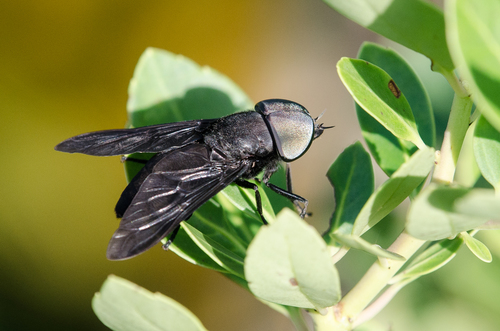


Black Horse Fly
tabanus atratus
The black horse fly (Tabanus atratus) is a large, striking insect native to North America, known for its formidable size and deep black coloration. While male black horse flies feed exclusively on plant nectar and pollen, females are infamous for their painful bites, which they use to obtain blood meals necessary for egg development. These powerful fliers are common sights around livestock, marshes, and damp pastures during the warmth of summer. Despite their intimidating presence and reputation as pests, they play a vital ecological role as pollinators and as a food source for various birds, frogs, and predatory insects.
Lebensraum: Typically found near wet environments such as marshes, swamps, and ponds, as well as open pastures and woodlands where livestock are present.
The black horse fly is easily identified by its large size, typically measuring between 2.0 to 2.8 centimeters in length, and its entirely black or very dark brown body. Its large, broad wings are uniformly dark brown to black, and its massive compound eyes cover a significant portion of its head. In males, these eyes touch at the top of the head, whereas in females they are separated by a small gap. The stout body is covered in fine, dark hairs, giving it a matte or slightly velvety appearance.
Kategorie
InsektenSeltenheit
Common
Gefahr
1/5 · Sehr gering
Snaps
Mach den ersten Snap!
Black horse flies are strongly attracted to dark, moving shapes and carbon dioxide, which is how they locate large mammalian hosts like horses and cattle.
Only female black horse flies bite; males lack the mouthparts required to pierce skin and feed solely on nectar and pollen.
Their larvae are highly predatory and possess sharp fangs with which they inject venom to paralyze small aquatic organisms and earthworms.
They are among the fastest flying insects, capable of reaching speeds that allow them to easily chase down running animals.
Females possess scissor-like mandibles that slice open the skin of hosts to lap up blood, rather than piercing like mosquitoes.
They are exceptionally fast and agile fliers, capable of keeping pace with running mammals to secure a blood meal.
They use specialized vision to detect polarized light, helping them locate water bodies for egg-laying and navigate their environment.
Adult males feed strictly on plant juices and nectar, whereas females require mammalian blood meals to develop their eggs; larvae are voracious predators of aquatic invertebrates.
Bos taurus
Female flies bite and feed on the blood of livestock for reproductive nourishment.
Anax junius
Adult horse flies are captured on the wing and consumed by large dragonflies.
Charadrius vociferus
The larvae and occasionally adults of the fly are eaten by shorebirds foraging in muddy habitats.
Für dieses Objekt sind noch keine Merkmal-Badges vergeben.
Noch keine Alternativnamen vorhanden.
Sammlungen für dieses Objekt erscheinen hier, wenn weitere Themen hinzugefügt werden.
Gefahr
1/5 · Sehr gering
Noch keine besonderen Sicherheitshinweise.
Der einfachste Weg, Black Horse Fly zu bestimmen, ist die Verwendung der Naturführer-App Snappit.
Adult males feed strictly on plant juices and nectar, whereas females require mammalian blood meals to develop their eggs; larvae are voracious predators of aquatic invertebrates.
Typically found near wet environments such as marshes, swamps, and ponds, as well as open pastures and woodlands where livestock are present.
Pursuit22019970929281313171815161720232426272528303332353134363738404245414443464748495051525354555657585960616263646566676869707172737475767778798081828384858687888990919293949596979899100101102103104105106107108109110111112113114115116117118119120121122123124125126127128129130131132133134135136137138139140141142143144145146147148149150151152153154155156157158159160161162163164165166167168169170171172173174175176177178179180181182183184185186187188189190191192193194195196197198199200201202203204205206207208209210211212213214215216217218219220221222223224225226227228229230231232233234235236237238239240241242243244245246247248249250
100+
Zoome hinein, um Cluster aufzulösen und zu sehen, wo dieses Objekt fotografiert wurde.
Neueste Snaps erscheinen hier, wenn neue Beobachtungen hinzukommen.

















