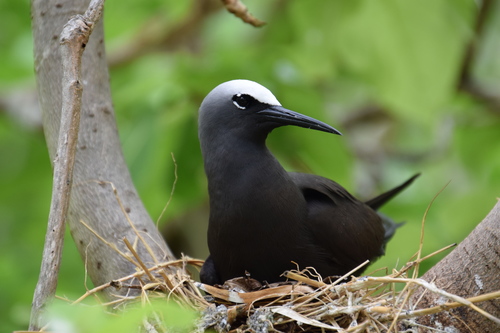


Black Noddy
anous minutus
The Black Noddy is a sleek, dark-plumaged seabird that graces tropical and subtropical oceans around the world. Unlike its ground-nesting relatives, this clever member of the tern family is famous for nesting high in tree canopies on offshore islands, often utilizing leaves and guano to construct secure platforms. Known for their delicate silhouettes and acrobatic flight, Black Noddies are a joy to watch as they flutter closely over the ocean surface to snatch up small fish and squid driven upward by underwater predators. These birds are highly social, forming massive, bustling breeding colonies that fill the island air with a cacophony of chattering calls. Because they rely heavily on healthy marine ecosystems, their presence is a key indicator of local ocean health.
Lebensraum: Typically found on tropical and subtropical offshore islands, cayes, and coral atolls with dense woody vegetation or mangroves for nesting.
The Black Noddy is identified by its charcoal-black to dark brown plumage, contrasted sharply by a bright white cap on its forehead that shades gently into a grey nape. It has a long, slender, and slightly down-curved black bill, dark brown eyes, and blackish legs with orange-tinted webs. Smaller and darker than the closely related Brown Noddy, it reaches about 35 to 38 centimeters in length with a wingspan of approximately 65 to 74 centimeters, allowing for highly agile and buoyant flight maneuvers.
Kategorie
VögelSeltenheit
Common
Gefahr
1/5 · Sehr gering
Snaps
Mach den ersten Snap!
Black Noddies use their own guano as a binding agent to glue their nests securely to tree branches.
Their common name 'Noddy' comes from their breeding displays, during which pairs repeatedly nod their heads at each other.
They often forage in symbiotic association with predatory fish like tuna, which push small prey up to the surface.
Unlike many other terns that plunge-dive, Black Noddies rarely submerge themselves, preferring to hover and scoop prey from the surface.
Constructs sturdy nests in trees and shrubs using a mixture of leaves, twigs, and guano, which acts as a natural cement.
Exhibits exceptional flight control to snatch small fish and squid directly from the ocean surface without getting wet or diving.
Possesses specialized supraorbital glands that extract excess salt from the bloodstream, allowing the bird to survive entirely on seawater.
Feeds primarily on small schooling fish and squid that are forced to the surface by larger marine predators like tuna.
Altersunterschiede: Chicks are fed regurgitated, semi-digested fish and squid by both parents until they fledge.
Gygis alba
Competes for nesting sites and foraging grounds in the same tropical island habitats.
Pisonia grandis
Uses the branches of this tree for nesting, though sticky seeds can sometimes trap and kill the birds.
Rattus exulans
Preys upon eggs and helpless nestlings within the nesting colonies.
Für dieses Objekt sind noch keine Merkmal-Badges vergeben.
Noch keine Alternativnamen vorhanden.
Sammlungen für dieses Objekt erscheinen hier, wenn weitere Themen hinzugefügt werden.
Gefahr
1/5 · Sehr gering
Noch keine besonderen Sicherheitshinweise.
Der einfachste Weg, Black Noddy zu bestimmen, ist die Verwendung der Naturführer-App Snappit.
35+ cm
65+ cm
0.08+ kg
10+ Jahre
50 km/h
Feeds primarily on small schooling fish and squid that are forced to the surface by larger marine predators like tuna.
Typically found on tropical and subtropical offshore islands, cayes, and coral atolls with dense woody vegetation or mangroves for nesting.
Zoome hinein, um Cluster aufzulösen und zu sehen, wo dieses Objekt fotografiert wurde.
Neueste Snaps erscheinen hier, wenn neue Beobachtungen hinzukommen.
















