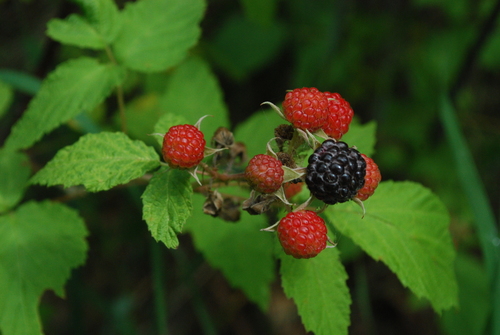


Black Raspberry
rubus occidentalis
Black Raspberry (Rubus occidentalis) is a popular native North American cane fruit known for its delicious, dark purple to black berries. This perennial shrub, a member of the rose family, is cherished for both its wild abundance and its cultivated varieties. It plays an important ecological role, providing food for wildlife and stabilizing soil, while its vibrant fruit offers a unique blend of sweet and tart flavors, making it a favorite for jams, pies, and fresh eating. Its distinctive arching canes and thorny nature are key characteristics that make it recognizable in diverse landscapes across its range.
Lebensraum: Found thriving in open woodlands, forest edges, clearings, fence rows, and disturbed areas, often in full sun to partial shade with well-drained loamy soil.
Black Raspberries are characterized by their arching, often purplish-red canes that can grow 1-3 meters long, typically covered in stiff, hooked prickles (thorns). The leaves are compound, usually with three to five leaflets, green on top and whitish or silvery underneath. Small, white, five-petaled flowers appear in clusters in spring, followed by globose fruits that ripen from green to red, eventually becoming a deep purplish-black in mid-summer. Unlike blackberries, black raspberries detach cleanly from their core, leaving a hollow receptacle.
Kategorie
PflanzenSeltenheit
Common
Gefahr
1/5 · Sehr gering
Snaps
Mach den ersten Snap!
Black raspberries are known to have one of the highest antioxidant levels among all fruits, surpassing even blueberries and pomegranates.
The canes of the black raspberry are biennial; they grow vegetatively in their first year (primocanes) and produce fruit and die in their second year (floricanes), while the root system remains perennial.
The hollow core left when a black raspberry is picked is a key identifier, distinguishing it from blackberries which retain their core.
The unique purple dye derived from black raspberries has historically been used to dye wool and other fabrics.
Its canes are covered in stiff, hooked prickles, providing an effective physical defense against herbivores that might otherwise consume its leaves and developing fruits.
When the tips of its arching canes touch the ground, they can root and form new plants (tip layering), allowing it to efficiently spread clonally and colonize new areas.
The deep purplish-black berries are packed with antioxidants and offer a sweet-tart flavor, making them highly attractive to birds and mammals, which then disperse the seeds.
As a photosynthetic organism, the Black Raspberry produces its own food by converting light energy from the sun into chemical energy, using water and carbon dioxide.
Apis mellifera
Pollinates flowers, aiding in reproduction.
Turdus migratorius
Consumes ripe fruit, dispersing seeds through its droppings.
Odocoileus virginianus
Browses on leaves and young shoots, especially in winter.
Procyon lotor
Consumes ripe fruit, dispersing seeds through its droppings.
Für dieses Objekt sind noch keine Merkmal-Badges vergeben.
Noch keine Alternativnamen vorhanden.
Sammlungen für dieses Objekt erscheinen hier, wenn weitere Themen hinzugefügt werden.
Gefahr
1/5 · Sehr gering
Noch keine besonderen Sicherheitshinweise.
Der einfachste Weg, Black Raspberry zu bestimmen, ist die Verwendung der Naturführer-App Snappit.
100-300 cm
0.5-1.5 kg
3-10 Jahre
As a photosynthetic organism, the Black Raspberry produces its own food by converting light energy from the sun into chemical energy, using water and carbon dioxide.
Found thriving in open woodlands, forest edges, clearings, fence rows, and disturbed areas, often in full sun to partial shade with well-drained loamy soil.
Photosynthesis
Zoome hinein, um Cluster aufzulösen und zu sehen, wo dieses Objekt fotografiert wurde.
Neueste Snaps erscheinen hier, wenn neue Beobachtungen hinzukommen.