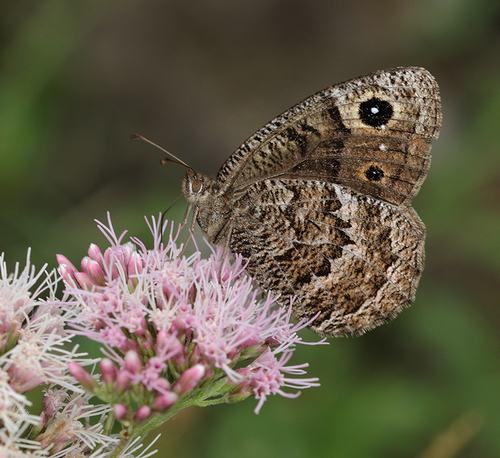


Black Satyr
satyrus actaea
The Black Satyr (Satyrus actaea) is a striking, dark-winged butterfly belonging to the brush-footed butterfly family Nymphalidae. Widely distributed across the rocky slopes, dry grasslands, and scrublands of Southwestern Europe, this insect is renowned for its elegant, low-to-the-ground flight and its remarkable ability to blend seamlessly into its surroundings when at rest. Unlike many brightly colored butterflies, the Black Satyr embraces a darker, understated palette that aids in thermoregulation and camouflage, making it a master of survival in harsh, sun-baked environments.
Lebensraum: Found in dry, rocky, and grassy hillsides, scrubby mountain slopes, and open woodlands up to elevations of 2,000 meters.
This medium-sized butterfly features a velvety dark-brown to charcoal-black upperside on its wings, which is especially intense and dark in males. The forewing is adorned with a prominent apical eyespot (ocellus) featuring a distinct white pupil, and occasionally a smaller second eyespot below it. The underside of the wings is intricately mottled with shades of grey, brown, and black, mimicking dry bark or lichen-covered rocks, providing perfect camouflage when its wings are closed.
Kategorie
InsektenSeltenheit
Common
Gefahr
1/5 · Sehr gering
Snaps
Mach den ersten Snap!
Male Black Satyrs use specialized scales called androconia to release pheromones that attract females during courtship flights.
They spend the winter as young caterpillars, hibernating near the base of grass tufts before completing their development in the spring.
When startled, they quickly drop to the ground and tilt their bodies, casting a minimal shadow to enhance their camouflage against the rocks.
Features circular eyespots on its forewings that draw the attention of avian predators away from its vulnerable body towards the expendable wing margins.
When resting on the ground with folded wings, its complex, mottled grey and brown underside allows it to perfectly resemble a small stone or piece of bark.
Uses its dark wing coloration to rapidly absorb solar radiation, allowing it to remain active during cool morning hours on sun-warmed rocks.
As caterpillars, they feed on various wild grasses, while the adult butterflies drink nectar from flowers, tree sap, and moisture from damp ground.
Altersunterschiede: Larvae feed strictly on the leaves of grasses such as Brachypodium and Festuca, whereas adults feed on liquid nectar and sap.
Brachypodium pinnatum
Larvae feed on the leaves of this common grass species.
Thymus serpyllum
Adults drink nectar from the purple flowers of this plant.
Mantis religiosa
This predatory insect ambushes adult butterflies on flowers.
Für dieses Objekt sind noch keine Merkmal-Badges vergeben.
Noch keine Alternativnamen vorhanden.
Sammlungen für dieses Objekt erscheinen hier, wenn weitere Themen hinzugefügt werden.
Gefahr
1/5 · Sehr gering
Noch keine besonderen Sicherheitshinweise.
Der einfachste Weg, Black Satyr zu bestimmen, ist die Verwendung der Naturführer-App Snappit.
2+ cm
4+ cm
0.0001+ kg
1+ Jahre
12 km/h
As caterpillars, they feed on various wild grasses, while the adult butterflies drink nectar from flowers, tree sap, and moisture from damp ground.
Found in dry, rocky, and grassy hillsides, scrubby mountain slopes, and open woodlands up to elevations of 2,000 meters.
Zoome hinein, um Cluster aufzulösen und zu sehen, wo dieses Objekt fotografiert wurde.
Neueste Snaps erscheinen hier, wenn neue Beobachtungen hinzukommen.















