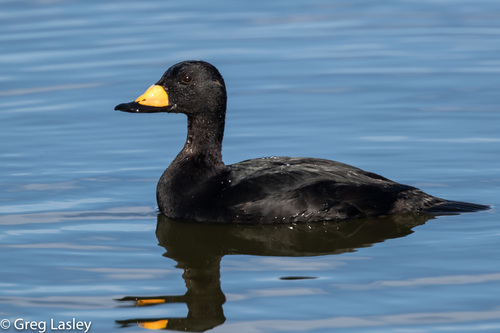


Black Scoter
melanitta americana
The Black Scoter (Melanitta americana) is a charismatic sea duck known for its striking all-black plumage in males and its distinctive bill. These highly social birds are powerful divers, spending much of their time foraging for shellfish and marine invertebrates in coastal waters and large freshwater bodies. Black Scoters are strong fliers and undertake extensive migrations, forming large, often dense flocks during their non-breeding seasons. Their unique vocalizations and impressive synchronized diving behaviors make them a fascinating species for birdwatchers and naturalists, highlighting their adaptation to harsh aquatic environments.
Lebensraum: Found primarily in coastal marine environments, estuaries, and large freshwater lakes during winter, and breeding in arctic and subarctic tundra ponds and boreal forest lakes.
Adult male Black Scoters are entirely matte black, with a prominent, bulbous orange-yellow knob at the base of their black bill. Their eyes are dark. Females are dark brownish-black overall, with paler, contrasting cheeks and a dark cap. Their bill is dark and lacks the male's distinctive knob. They are medium-sized ducks, typically appearing bulky with a long body and relatively short tail. In flight, they show all-dark wings, which are held stiffly.
Kategorie
VögelSeltenheit
Common
Gefahr
1/5 · Sehr gering
Snaps
Mach den ersten Snap!
During migration and winter, Black Scoters often form enormous, dense rafts on open water, sometimes numbering in the tens of thousands.
Male Black Scoters are unique among ducks for their entirely black plumage and the distinctive orange-yellow knob at the base of their bill.
Their call is often described as a soft, whistly 'poo-poo' or 'pew-pew', a unique sound among sea ducks.
Unlike many ducks, Black Scoters typically take flight by running across the water's surface, requiring a considerable 'runway' to become airborne.
Black Scoters are expert divers, capable of submerging for extended periods to forage on the seafloor. They use their powerful webbed feet to propel themselves underwater, reaching depths of several meters.
When foraging in flocks, Black Scoters often dive simultaneously in a coordinated fashion. This behavior helps them efficiently exploit food resources and may offer some protection from predators by confusing them.
Their unique bill, particularly the large knob in males, is adapted for prying mollusks and other benthic invertebrates from rocks and substrate. The strong, somewhat flattened bill helps crush shells.
Black Scoters are primarily carnivores, feeding almost exclusively on benthic invertebrates. They dive to the bottom of aquatic habitats to extract their prey.
Vulpes lagopus
Arctic foxes may prey on eggs and young ducklings in nesting colonies.
Haliaeetus leucocephalus
Bald Eagles are opportunistic predators and may prey on adult scoters, especially during winter months when scoters are concentrated on coastal waters.
Mytilus edulis
Mussels are a primary food source for Black Scoters, which dive to consume them from the seafloor.
Larus argentatus
Gulls may sometimes attempt to kleptoparasitize scoters, stealing food that they have brought to the surface.
Für dieses Objekt sind noch keine Merkmal-Badges vergeben.
Noch keine Alternativnamen vorhanden.
Sammlungen für dieses Objekt erscheinen hier, wenn weitere Themen hinzugefügt werden.
Gefahr
1/5 · Sehr gering
Noch keine besonderen Sicherheitshinweise.
Der einfachste Weg, Black Scoter zu bestimmen, ist die Verwendung der Naturführer-App Snappit.
43-56 cm
79-88 cm
0.9-1.5 kg
10-15 Jahre
90 km/h
Black Scoters are primarily carnivores, feeding almost exclusively on benthic invertebrates. They dive to the bottom of aquatic habitats to extract their prey.
Found primarily in coastal marine environments, estuaries, and large freshwater lakes during winter, and breeding in arctic and subarctic tundra ponds and boreal forest lakes.
Zoome hinein, um Cluster aufzulösen und zu sehen, wo dieses Objekt fotografiert wurde.
Neueste Snaps erscheinen hier, wenn neue Beobachtungen hinzukommen.














.jpg&width=800)
