

Black Sea Bass
centropristis striata
The Black Sea Bass (Centropristis striata) is a fascinating and highly sought-after marine fish native to the western Atlantic Ocean. Belonging to the grouper family, it is renowned for its striking appearance and intriguing life cycle, most notably its ability to change sex from female to male as it matures. These bottom-dwelling fish are a vital part of structured marine ecosystems, frequently congregating around rocky reefs, oyster beds, and shipwrecks where they act as opportunistic ambush predators. Aside from their ecological importance, Black Sea Bass are highly valued in both recreational and commercial fisheries due to their delicious, firm white meat. They are known for their seasonal migrations, moving to deeper offshore waters in the winter and returning to shallow coastal areas in the warmer months. This dynamic lifestyle and unique biology make the Black Sea Bass a true marvel of the coastal Atlantic.
Lebensraum: Typically found in coastal and offshore marine waters, strongly preferring structured bottom environments like rocky reefs, artificial wrecks, and oyster beds.
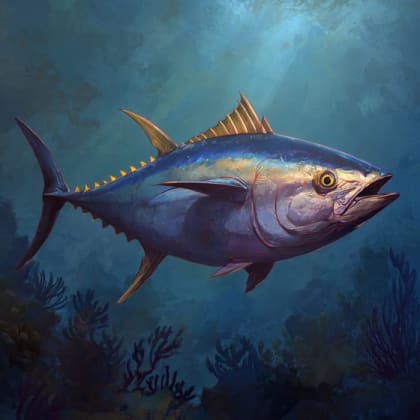
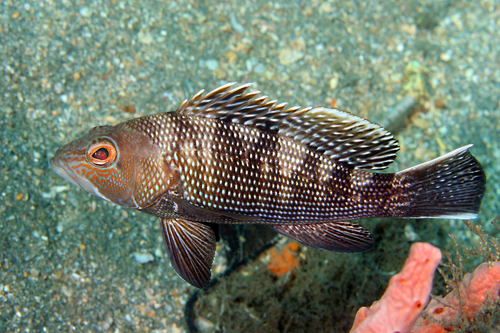
Black Sea Bass have a stout, grouper-like body with a large head and a prominent, wide mouth. Their coloration is typically a dusky brown to smoky black, but they feature distinct, pale dots on their scales that form faint longitudinal stripes. Mature males are particularly striking, developing a bright, fluorescent blue hump on their heads and vivid blue streaks around their eyes during the spawning season. The dorsal fin is tall and continuous, marked with white streaks, while the caudal (tail) fin is rounded and frequently features a long, trailing filament extending from the top edge in older adults.
Kategorie
FischeSeltenheit
Common
Gefahr
1/5 · Sehr gering
Snaps
Mach den ersten Snap!
During the winter, populations in the Mid-Atlantic migrate offshore to deeper, warmer waters to avoid freezing coastal temperatures.
Most Black Sea Bass start their lives as females; as they grow older and larger, they undergo a natural sex change to become males.
Older male Black Sea Bass develop a distinctive, long trailing filament on their tail fin that can look like a thin ribbon.
They are actually members of the grouper family (Serranidae), despite their relatively small size compared to giant tropical groupers.
The majority of Black Sea Bass are born female and transition into fully functional males between the ages of two and five.
Dominant males can rapidly alter their coloration, developing brilliant neon blue markings and a pronounced nuchal hump to attract females during spawning.
They possess a highly protrusible jaw that rapidly expands to create a powerful vacuum, instantly inhaling unsuspecting prey from crevices.
Black Sea Bass are opportunistic bottom-feeding carnivores that prey heavily on crustaceans, mollusks, and smaller fish.
Altersunterschiede: Juveniles feed primarily on tiny benthic invertebrates and zooplankton, shifting to larger crustaceans and fish as their mouth gape increases.
Mustelus canis
Natural predator of juvenile and adult black sea bass in coastal habitats.
Cancer irroratus
Black sea bass use their powerful jaws to crush and consume these hard-shelled crustaceans.
Paralichthys dentatus
Shares similar benthic habitats and competes for the same crustacean and small fish food sources.
Für dieses Objekt sind noch keine Merkmal-Badges vergeben.
Noch keine Alternativnamen vorhanden.
Sammlungen für dieses Objekt erscheinen hier, wenn weitere Themen hinzugefügt werden.
Gefahr
1/5 · Sehr gering
Noch keine besonderen Sicherheitshinweise.
Der einfachste Weg, Black Sea Bass zu bestimmen, ist die Verwendung der Naturführer-App Snappit.
30-60 cm
1-4 kg
8-12 Jahre
Black Sea Bass are opportunistic bottom-feeding carnivores that prey heavily on crustaceans, mollusks, and smaller fish.
Typically found in coastal and offshore marine waters, strongly preferring structured bottom environments like rocky reefs, artificial wrecks, and oyster beds.
Ambush
30000-95000
Zoome hinein, um Cluster aufzulösen und zu sehen, wo dieses Objekt fotografiert wurde.
Neueste Snaps erscheinen hier, wenn neue Beobachtungen hinzukommen.