

Black Wattle
acacia mearnsii
The Black Wattle (Acacia mearnsii) is a fast-growing leguminous tree native to southeastern Australia. Famed for its beautiful feathery foliage and fragrant pale yellow blooms, this resilient plant holds a dual reputation: it is both a highly valued commercial resource for tannin production and one of the world's most aggressive invasive species. It thrives in diverse climates, rapidly colonizing disturbed soils and altering ecosystems to its advantage. In its native habitats, it plays an important ecological role by stabilizing soils and providing habitat. However, when introduced abroad, its high reproductive rate, massive seed bank, and tolerance to fire allow it to easily displace native vegetation and deplete precious water resources.
Lebensraum: Typically found in open woodlands, forest margins, riparian zones, grasslands, and disturbed areas like roadsides.
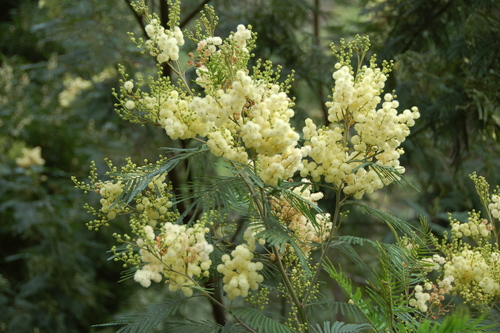
The Black Wattle is a small to medium-sized evergreen tree, typically reaching heights between 5 and 15 meters. It features dark olive-green, bipinnate leaves that have a soft, feathery appearance due to hundreds of tiny, tightly packed leaflets. Its bark is smooth and greenish-black on younger branches, maturing into a rough, dark brown to blackish bark with deep fissures. During late winter and spring, it produces spectacular, dense clusters of globular, pale yellow or cream-colored flowers that emit a sweet scent, which later develop into flat, dark brown, jointed seed pods.
Kategorie
PflanzenSeltenheit
Common
Gefahr
1/5 · Sehr gering
Snaps
Mach den ersten Snap!
A single mature tree can produce tens of thousands of seeds each year, which can remain viable and sleep in the soil for up to 50 years before germinating.
Its bark contains an incredibly high concentration of soluble tannins (up to 40%), making it one of the premier global sources for vegetable leather tanning.
The Black Wattle is listed by the IUCN as one of the world's 100 worst invasive alien species.
Formulates mutualistic bonds with Rhizobium bacteria in its roots to convert atmospheric nitrogen into usable soil nutrients, allowing it to colonize nutrient-poor soils.
Produces seeds with a tough outer coat that can lie dormant in the soil for decades, which are stimulated to germinate rapidly en masse following the heat of a wildfire.
Releases chemical compounds from its roots and decomposing leaf litter into the surrounding soil, inhibiting the germination and growth of competing native plant species.
As an autotrophic plant, the Black Wattle produces its own energy via photosynthesis, absorbing sunlight, water, carbon dioxide, and essential soil minerals.
Rhizobium leguminosarum
Establishes a mutualistic relationship where the bacteria fix nitrogen in the tree's root nodules.
Melanterius macrophylla
The larvae of this weevil feed directly on the developing seeds inside the pods, acting as a biological control agent.
Imbrasia cytherea
The large, colorful caterpillars of this moth feed heavily on the tree's foliage in areas where the tree is introduced.
Für dieses Objekt sind noch keine Merkmal-Badges vergeben.
Noch keine Alternativnamen vorhanden.
Sammlungen für dieses Objekt erscheinen hier, wenn weitere Themen hinzugefügt werden.
Gefahr
1/5 · Sehr gering
Noch keine besonderen Sicherheitshinweise.
Der einfachste Weg, Black Wattle zu bestimmen, ist die Verwendung der Naturführer-App Snappit.
500-2000 cm
10-30 Jahre
As an autotrophic plant, the Black Wattle produces its own energy via photosynthesis, absorbing sunlight, water, carbon dioxide, and essential soil minerals.
Typically found in open woodlands, forest margins, riparian zones, grasslands, and disturbed areas like roadsides.
Zoome hinein, um Cluster aufzulösen und zu sehen, wo dieses Objekt fotografiert wurde.
Neueste Snaps erscheinen hier, wenn neue Beobachtungen hinzukommen.


















.jpg&width=800)
